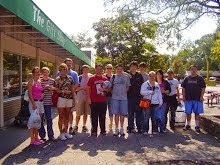
You never age out of Our Place
Day program, started by parents, helps young people with developmental disabilities build social skills
http://www.chicagotribune.com/health/ct-x-n-wilmette-our-place-20101117,0,5165944,full.story
Travis Tassone stood in the center of the room and crooned an Elvis tune for his teenage friends when it happened, again.
"Toenails!" he blurted. He clapped his hands to his mouth. He was trying so hard not to say that word. It's one of those expressions — like "Merry Christmas" — that he says compulsively.
"I'm sorry …" he said.
Life is filled with such small struggles at Our Place, a day program in downtown Wilmette for young people with developmental disabilities. The program was started almost two years ago by parents who saw a gap in social services and filled it.
Tassone, 19, has Down syndrome. More than two dozen other young adults in the program have autism, cerebral palsy and other conditions from birth that leave them with no clear path for jobs and housing.
Increasingly, parents frustrated with the state's waiting lists and funding woes are forming nonprofit corporations such as Our Place of New Trier Township to keep their children busy and closer to home. Special education services end when students reach 22, leaving few options for young adults with disabilities in Illinois.
Jane Gallery, of Winnetka, enlisted the help of others and modeled the program after a community senior citizen center. Other families have formed "microboards" that focus attention on one individual's needs, or cooperatives that involve several families.
The common goal is to form a circle of support that involves family members, friends and service providers who determine how to help the young people succeed and enjoy their lives.
Otherwise, "when you turned 22, you stayed home and watched television," Gallery said. "That's what my son was doing."
Her son, Frank Craven, had experienced the best special education services that New Trier Township High School had to offer, but Gallery knew the day would come when he aged out of programs that gave his life meaning. She could drive him an hour away from his community to participate in a factory-type work program, but what he really needs, she said, is to improve his social skills and find a job closer to home.
Our Place is a safe setting to work on such challenges.
"It reminds me very much of how the whole movement for providing services for people with developmental disabilities started in the 1950s," said Sandy Ryan, director of program and policy for the Illinois Council on Developmental Disabilities. "There was nothing. So families got together in church basements out of necessity and started programs."
Our Place focuses on improving social skills through recreation and community service, with a goal to add vocational training. Located at the Community Church of Wilmette, the program quickly attracted 30 participants and saw its budget surge from $25,000 in 2009 to $150,000 this year, Gallery said.
The program's after-school hours have been especially helpful for single parents, including Vickie Tassone. Her son, Travis, stays busy with Special Olympics and a part-time job, but he had no place to relax with friends after school.
"All the other kids his age are hanging out doing sports," Tassone said. "Our Place just opened that up for kids with special needs. There was never that venue for them, to have a safe place for him to be and to be supervised."
One afternoon, Craven played a North Shore version of Monopoly with friends. He purchased the Baha'i Temple for $3 in fake money and landed on Winnetka Sidewalk Sales a minute later.
Across from him, John Merrill, 22, clutched a clipboard tightly to his chest. Like Tassone, he obsesses on certain tasks and words, which are contained in a list on his clipboard. He checks off each one when he uses up his daily allotment.
Nearby, John Lee, 18, waited his turn for Wii bowling, rocking gently on his heels, making fluttering movements with his hands and smiling broadly. His mother was nervous about signing him up for the program but gradually increased one-hour visits to longer stays because he was so happy there.
"There is always that sense of relief on my part because socializing is not as easy for children on the (autism) spectrum," said Jane Heine, of Wilmette. "John is a sweet boy and so kind, but sensory-wise, a busy place can be distracting."
Organizers hope to immerse the young adults in community life, bringing them into downtown shops and helping them find their niche in work and recreation. One young man, for instance, works part-time at a bank where he verifies information on loan documents because he is good with numbers.
Gallery's son, now 23, has always been shy. "It used to be like pulling teeth to get him to talk about his day," she said. "Now he initiates conversation."
Private donations, fundraisers and grants have helped Our Place afford to hire several staff members and to pay rent for church space. Volunteers from the area high schools help lead activities, which include art classes, poetry readings, trips to the beach and gardening. The participants, age 16 and older, pay a fee to enroll in 10-week sessions that are offered from noon to 6 p.m. weekdays, along with a Saturday social.
No one will grow too old to visit Our Place, as it is intended to form lasting social ties.
Stacia Swan, program director, has worked hard to let the young people know what to expect at Our Place. Every day begins with a warm-up song before participants separate into groups that rotate among activities. Each session ends with gentle yoga and breathing exercises.
Swan is mindful that these are young adults, and resists any urge to talk down to them or lead activities that are intended for young children.
During "circle time," Swan talks about relationships, dating and other more personal issues. A poster displayed on the wall depicts proper social norms, such as when to greet people with a hug, half-hug or handshake.
"Transitions are hard," said Swan, who eases tension if she notices someone is anxious or troubled. "Structure is so important to them."
For instance, one young man refrained from joining the group one day last week when all moved outdoors. He stood close to the building, checking his watch every few minutes, while others played a raucous game involving a parachute and beach balls. A volunteer gently prodded him to join the others, but did not force him to participate.
Slowly, he edged closer to the others. He checked his watch one more time. And then joined in.
Tuesday, December 7, 2010

Thanksgiving comes early for Dexter Middle students
Thanksgiving comes early for Dexter Middle students
http://www.whittierdailynews.com/news/ci_16630627
WHITTIER - Sixth-, seventh- and eighth-grade special education students at Dexter Middle School celebrated an early Thanksgiving on campus Tuesday, part of an annual tradition that prepares them for the holiday ahead.
For some of the students, whose disabilities run the gamut from autism to auditory processing disorders, it's the only chance they'll have to enjoy a formal holiday sit-down with friends, said Special Day Class teacher Judith Ledon-Piñon.
But it takes weeks of preparation. Eighth-graders helped teachers shop for supplies and work out budgets at the grocery store. Classroom lessons this month were geared toward teaching manners, courtesy, responsibility, and treating others with respect.
"In special education, you either have parents who are very involved with them and parents who aren't involved at all," said Ledon-Piñon, who planned the dinner with fellow special education teachers Fred Eldridge and Mario Malagon.
"So we wanted to create an environment where the kids can grow and be successful as a family," she added. "That way, when they're in high school, they can look out for each other, have someone to depend on."
Nearly 50 students filed into the school cafeteria Wednesday afternoon for a huge meal of turkey, stuffing, mashed potatoes, spinach salad, rolls and fruit salad.
And as they sat with their fellow classmates, they practiced their table manners, like asking to be excused before getting up from their seats and passing items to each other in a clockwise direction.
"I think this is a good way to show our manners," said seventh-grader Marie Aranki, 13. "But my favorite part of this is eating the food."
The WorkAbility program at Whittier High, which seeks to help disabled students transition to independent lives after school, donated the turkeys and also provided weekly lessons for the students.
But for Dexter Principal Diana Kinnart, watching the students excitedly interact with each other while enjoying their meals nearly brought tears to her eyes.
"Our teachers are not only teaching the academics, but they're going above and beyond with programs like this," said Kinnart. "They know many of these students don't have the opportunity to do this on their own."
Read more: Thanksgiving comes early for Dexter Middle students - Whittier Daily News http://www.whittierdailynews.com/news/ci_16630627#ixzz17T6EA6jm
http://www.whittierdailynews.com/news/ci_16630627
WHITTIER - Sixth-, seventh- and eighth-grade special education students at Dexter Middle School celebrated an early Thanksgiving on campus Tuesday, part of an annual tradition that prepares them for the holiday ahead.
For some of the students, whose disabilities run the gamut from autism to auditory processing disorders, it's the only chance they'll have to enjoy a formal holiday sit-down with friends, said Special Day Class teacher Judith Ledon-Piñon.
But it takes weeks of preparation. Eighth-graders helped teachers shop for supplies and work out budgets at the grocery store. Classroom lessons this month were geared toward teaching manners, courtesy, responsibility, and treating others with respect.
"In special education, you either have parents who are very involved with them and parents who aren't involved at all," said Ledon-Piñon, who planned the dinner with fellow special education teachers Fred Eldridge and Mario Malagon.
"So we wanted to create an environment where the kids can grow and be successful as a family," she added. "That way, when they're in high school, they can look out for each other, have someone to depend on."
Nearly 50 students filed into the school cafeteria Wednesday afternoon for a huge meal of turkey, stuffing, mashed potatoes, spinach salad, rolls and fruit salad.
And as they sat with their fellow classmates, they practiced their table manners, like asking to be excused before getting up from their seats and passing items to each other in a clockwise direction.
"I think this is a good way to show our manners," said seventh-grader Marie Aranki, 13. "But my favorite part of this is eating the food."
The WorkAbility program at Whittier High, which seeks to help disabled students transition to independent lives after school, donated the turkeys and also provided weekly lessons for the students.
But for Dexter Principal Diana Kinnart, watching the students excitedly interact with each other while enjoying their meals nearly brought tears to her eyes.
"Our teachers are not only teaching the academics, but they're going above and beyond with programs like this," said Kinnart. "They know many of these students don't have the opportunity to do this on their own."
Read more: Thanksgiving comes early for Dexter Middle students - Whittier Daily News http://www.whittierdailynews.com/news/ci_16630627#ixzz17T6EA6jm
Disability Summit Promotes Self-Advocacy
Disability Summit Promotes Self-Advocacy
Staunton, Va.
http://www.whsv.com/news/headlines/Disability_Summit_Promotes_Self-Advocacy_108269669.html?ref=669
It's a conference empowering disabled people to advocate for changes they want to see, and about 85 teens and young adults are meeting in Staunton Monday and Tuesday for that purpose.
The individuals have intellectual, physical, emotional or learning disabilities, but they say, no matter what the disability, they all have the same goal.
Tori Saylor is a 25 year old who works at a vet's office in Harrisonburg.
She has Aspergers and says this youth summit has empowered her to be a self-advocate.
"Your disability is a part of you, but it's not the whole you. And so being proud of it just opens your eyes to a whole new world," says Saylor.
Matthew Shapiro,a sophomore at Virginia Commonwealth University, has cerebral palsy and has been in a wheelchair all his life.
He says it's frustrating to see people working on legislation or change who don't have a disability.
"And they try and tell us what we need, but they have no idea what I, as a person in a wheelchair, go through on a daily basis," says Shapiro.
He says things like easier accessibility help, but awareness is key.
"If you don't know that much about disabilities, it doesn't help if you know, down the road we need you to do something," says Shapiro.
Both Saylor and Shapiro say they want to be in classrooms and workplaces with others, because while they may have disabilities, they do have other strengths.
"There's a lot of talk about inclusion and including everybody. And it's not just helping us understand our disability, but it's helping them understand us and helping us understand them, so it helps all of us," says Saylor.
"People with disabilities can do amazing things, if we're given a fair chance to do them," says Shapiro.
Many of the youth at the conference say the event is also opening their eyes to services available to them.
Staunton, Va.
http://www.whsv.com/news/headlines/Disability_Summit_Promotes_Self-Advocacy_108269669.html?ref=669
It's a conference empowering disabled people to advocate for changes they want to see, and about 85 teens and young adults are meeting in Staunton Monday and Tuesday for that purpose.
The individuals have intellectual, physical, emotional or learning disabilities, but they say, no matter what the disability, they all have the same goal.
Tori Saylor is a 25 year old who works at a vet's office in Harrisonburg.
She has Aspergers and says this youth summit has empowered her to be a self-advocate.
"Your disability is a part of you, but it's not the whole you. And so being proud of it just opens your eyes to a whole new world," says Saylor.
Matthew Shapiro,a sophomore at Virginia Commonwealth University, has cerebral palsy and has been in a wheelchair all his life.
He says it's frustrating to see people working on legislation or change who don't have a disability.
"And they try and tell us what we need, but they have no idea what I, as a person in a wheelchair, go through on a daily basis," says Shapiro.
He says things like easier accessibility help, but awareness is key.
"If you don't know that much about disabilities, it doesn't help if you know, down the road we need you to do something," says Shapiro.
Both Saylor and Shapiro say they want to be in classrooms and workplaces with others, because while they may have disabilities, they do have other strengths.
"There's a lot of talk about inclusion and including everybody. And it's not just helping us understand our disability, but it's helping them understand us and helping us understand them, so it helps all of us," says Saylor.
"People with disabilities can do amazing things, if we're given a fair chance to do them," says Shapiro.
Many of the youth at the conference say the event is also opening their eyes to services available to them.
UMFS day school's expansion gives students more options
UMFS day school's expansion gives students more options
http://www2.timesdispatch.com/news/2010/nov/09/umfs09-ar-640281/
Richmond, Va. --
Goat cheese, balsamic vinegar, olive oil and garlic.
Before this year, you wouldn't have heard Kivon Matthews, 16, talking about foods like that, much less cooking with them.
Now she has expanded her horizons in a new culinary program at Charterhouse Day School at UMFS (United Methodist Family Services), part of an expansion that more than doubled the school's space and increased enrollment by more than half.
"We cook things we didn't know about before," Matthews said. She added that even if nonculinary student Chris Martin, 15, turned up his nose at anything involving olive oil, she liked it.
When the school's new space is celebrated today on the UMFS grounds with a keynote speech by Richmond Mayor Dwight C. Jones, an open house will feature dishes prepared by Matthews and others in the new culinary program.
They have made country ham biscuits with orange and honey butter; tarragon chicken salad; roast beef and cheddar rolls; hummus served with vegetables and pita; mushroom tarts; and platters of domestic and imported cheeses, including marinated goat cheese.
One classroom will be filled with desserts like the seven-layer cookies that Matthews was making in a Friday "bake-a-thon" under the direction of culinary instructor Marie Fitzgerald.
"My day-school kids are awesome," Fitzgerald said. "There are no discipline problems. They get to cook. They get to eat. They're awesome."
Charterhouse Day School offers specialized education for middle school and high school students who aren't successful in a traditional school setting. Each classroom has a teacher and a behavioral specialist to deal with issues that range from learning disabilities to emotional disturbances to Asperger's syndrome. Before the expansion, the school had 25 to 27 students; now it has 42.
The $210,000 renovation created five classrooms in two UMFS cottages that most recently had been used by a program for senior citizens with Alzheimer's disease. Space increased from 5,000 to 11,300 square feet.
A new cosmetology program teaches work-related skills, much as the culinary program does. Cosmetology facilities are within the new school space, while the culinary program uses the kitchen in the UMFS dining hall.
UMFS also has a residential treatment program for 24 young people. About 285 active senior citizens live in Guardian Place apartments on campus.
Other services include foster-care programs, adoption services, intensive behavioral treatment, school-based services, and Project LIFE to prepare students for independent living as they age out of the foster-care system.
The new day-school facilities got a thumbs-up from several students last week.
Martin especially liked the new computer lab, which includes an interactive electronic whiteboard that he described as being like a game show set.
Norman Browning, 13, was also impressed: "It's a lot nicer than the old building."
http://www2.timesdispatch.com/news/2010/nov/09/umfs09-ar-640281/
Richmond, Va. --
Goat cheese, balsamic vinegar, olive oil and garlic.
Before this year, you wouldn't have heard Kivon Matthews, 16, talking about foods like that, much less cooking with them.
Now she has expanded her horizons in a new culinary program at Charterhouse Day School at UMFS (United Methodist Family Services), part of an expansion that more than doubled the school's space and increased enrollment by more than half.
"We cook things we didn't know about before," Matthews said. She added that even if nonculinary student Chris Martin, 15, turned up his nose at anything involving olive oil, she liked it.
When the school's new space is celebrated today on the UMFS grounds with a keynote speech by Richmond Mayor Dwight C. Jones, an open house will feature dishes prepared by Matthews and others in the new culinary program.
They have made country ham biscuits with orange and honey butter; tarragon chicken salad; roast beef and cheddar rolls; hummus served with vegetables and pita; mushroom tarts; and platters of domestic and imported cheeses, including marinated goat cheese.
One classroom will be filled with desserts like the seven-layer cookies that Matthews was making in a Friday "bake-a-thon" under the direction of culinary instructor Marie Fitzgerald.
"My day-school kids are awesome," Fitzgerald said. "There are no discipline problems. They get to cook. They get to eat. They're awesome."
Charterhouse Day School offers specialized education for middle school and high school students who aren't successful in a traditional school setting. Each classroom has a teacher and a behavioral specialist to deal with issues that range from learning disabilities to emotional disturbances to Asperger's syndrome. Before the expansion, the school had 25 to 27 students; now it has 42.
The $210,000 renovation created five classrooms in two UMFS cottages that most recently had been used by a program for senior citizens with Alzheimer's disease. Space increased from 5,000 to 11,300 square feet.
A new cosmetology program teaches work-related skills, much as the culinary program does. Cosmetology facilities are within the new school space, while the culinary program uses the kitchen in the UMFS dining hall.
UMFS also has a residential treatment program for 24 young people. About 285 active senior citizens live in Guardian Place apartments on campus.
Other services include foster-care programs, adoption services, intensive behavioral treatment, school-based services, and Project LIFE to prepare students for independent living as they age out of the foster-care system.
The new day-school facilities got a thumbs-up from several students last week.
Martin especially liked the new computer lab, which includes an interactive electronic whiteboard that he described as being like a game show set.
Norman Browning, 13, was also impressed: "It's a lot nicer than the old building."
Subscribe to:
Comments (Atom)