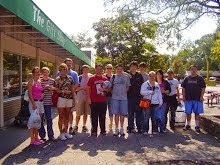
Coffee business booming at high schools
http://www.press-citizen.com/article/20101220/NEWS01/12200313/Coffee-business-booming-at-high-schools
Jordan Haganman pulled the apron over his head, tied the string behind his back and, standing behind the counter of City High's Café cart, greeted his classmates.
"Good morning," he said. "May I help you?"
Haganman, a senior, is one of the special education student employees who help man the City High Café cart during the course of a week at the school. He helps dispense and sell coffee in what has become a trend that has spread to West High, which opened its own coffee stand, Pump It Up, on Nov. 29.
"Kids are drinking a lot of coffee, so I thought why not make it more convenient?" said Diane Fickel, a West High business teacher who oversees the West High coffee stand, which is just west of the school's library.
The "Coffee Cart," as it had been known at City High, started about 10 years ago. It was eventually moved to a classroom, but it faded away after school officials banned containers with liquids in classrooms, said Brent DeNeice, a City High special education teacher who oversees City High's operation.
He said he saw students head to coffee shops such as Java House and Starbucks off campus, and when the student commons area opened in 2007, he decided to try the on-campus coffee stand again.
Since then, serving the coffee and hot cocoa in special cups with the City High Café logo on them, the business grew, using the talents of students from industrial tech, visual arts and the food and consumer sciences classes.
However, special education students make up the bulk of the work force for the cart, doing everything from making coffee and cleaning the cart to making change after a sale.
"We can knock off social skills," DeNeice said. "We're working on math. We're working on service. We're working on janitorial."
At West High, it was a busy morning recently at Pump It Up, as students besieged the stand, tucked into a closet by the business classrooms, for coffee and hot chocolate.
Fickel also employs functional special education students, pairing them with business students in period shifts. The coffee stand opened after the business students did marketing research and wrote a business plan.
Students who work in the stand get independent study class credit as they learn the ins and outs of running a business.
"We did all of the things you do to open a real business," Fickel said. "It's as true to life you can get to running a business."
Each coffee business also makes use of its profits.
Pump It Up uses proceeds for scholarships for business students to attend leadership conferences in Des Moines and Washington, D.C. and for special needs students to attend Camp Courageous, Fickel said. City High Café has given money to varied groups including the Iowa City Animal Shelter, Best Buddies, Fas Trac and the Mayor's Youth Empowerment Program.
"We try to make it a learning project for them," DeNeice said.
Friday, January 14, 2011

Life Academy better fit for special needs students
Life Academy better fit for special needs students
East Peoria, Ill. — When Sandy Valentine’s autistic son was 20 months old, doctors told the family that he would never be a functioning person.
“We had a doctor tell us to put him in a home. We’re glad we didn’t listen to him,” she said of her now 19-year-old son Jack Valentine. “He’s come a long way.”
Jack Valentine, who is non-verbal — a trait of 50 percent of cases of autism — is one of eight students in East Peoria Community High School’s Life Academy program for students 18 to 22 with an Individual Education Plan.
His mother credits much of his success to his three years in the program.
“It’s been really good for him,” she said. “He has become a functional member of the community. He’s a good kid. He’s easygoing and funny.”
Having revamped the Life Academy three years ago, the students are now giving back to the community they are a part of while gaining independence in the process.
Each week, they can be seen shopping at a grocery store, cleaning churches, volunteering at various organizations, among many other activities.
Revamping Life Academy
Erika Ridge, Life Academy teacher for the last eight years, said the program was transformed for one main reason — once the students participated in graduation ceremonies and came back to the Life Academy, it was almost as if they were just repeating their high school experience all over again.
“I really wanted to see something different for them,” Ridge said, adding she became inspired by transitional programs that schools were doing near Chicago. “The school said go for it, and we came up with a plan. ... The parents were so behind us and enthusiastic.”
The program includes four elements: “extensive community integration,” meaning they are out in the community three to four times a week; “functional academics,” or teaching everyday life skills like reading a recipe or paying for things in a store; “vocational development,” exposing them to different employment options; and a “parent component,” which includes helping parents make connections with various adult service organizations.
“It’s about working on those real life skills and doing it in an environment that makes sense,” she said.
In action
An example of one of these environments was Kroger in East Peoria, where the students could be seen Thursday morning picking out groceries for a lunch they were soon going to prepare.
“What are we looking for today?” she asked the students, one by one showing them a picture on a card of various grocery items.
“Buns,” said a student.
“Where are we going to find those buns?” she asked, again holding up pictures, but this time of the various aisles in the store.
Within a half hour the students had located all of the items they needed with the assistance of Ridge and her two aides.
“It really depends on what level they are at,” she said. “Some of them need pictures.”
Next, the group made their way in the Raider bus to the Fondulac Administration Building to cook.
Half of the group did an activity while the other half began cooking.
When asked what their favorite part of the class was, Tito Ouimet, 20, said “doing the dishes.”
Tyler Troyer, 19, said “patting the hamburgers.”
Ridge said the hands-on experience is the most important part of it all.
“Just because they can sit around a classroom table and count money, doesn’t mean they can do it at a store because everything is different. There’s people standing behind you. There’s this cashier. There’s lights, there’s sounds. There’s all these different things. It really prepares them more for what they’re really going to encounter.”
The Benefits
Sandy Valentine said her son now loves to shop with her.
“He likes to go to the store and touch things. He’s comfortable now and knows the routine,” she said. “I don’t think he’ll ever live alone, but he might live in a group home and do some of these things he’s learned.”
Other parents are happy with their children’s success, as well.
Gina Hogsett, mother of Sara Williams, 20, who has Down Syndrome, said the program has “helped tremendously.”
“She’s more active and willing to participate with kids. She’s talking more this year,” said Hogsett, adding she has learned to separate her laundry and help with the dishes.
“Her whole overall attitude is better,” she said. “Mrs. Ridge is the best person. She’s an asset, and I hope we don’t ever lose her.”
Principal Paul Whittington said Ridge was the brainchild behind every aspect of the program.
“She has a complete passion for these kids. She does a marvelous job,” he said. “Certainly you can see the benefits by just looking into these young adult’s faces.”
Autism program is a true holiday gift
Autism program is a true holiday gift
http://www.stltoday.com/lifestyles/health-med-fit/fitness/f3e8bcec-5a5f-53fa-9de6-47019dc0f229.html
Tommy Ney put an ornament or two on the Christmas tree in his family's living room last Monday. But he wasn't really feeling the moment.
The sky was gray and Tommy, who's 22, tall and husky, was more interested in checking on the weather.
A few years back, a storm knocked out the power at his family's home for several days. Now, when it's cloudy, he worries incessantly, opening and closing the sliding patio door several times an hour to get a closer look at the sky.
Christy Ney was pleased that her son put ornaments on the tree at all.
It was a first — one of many since he joined the Midwest Adult Autism Project three months ago.
Tommy has also started — on occasion — cleaning up after himself, following instructions, and keeping his hands to himself in public.
He isn't as "bangy" as he once was either, Christy Ney said, referring to how he'll suddenly pound his hands on his chair and yelp loudly.
"He's using personal pronouns, too," added his sister, Amy Ney, 20. She's noticed this since returning home a few days ago from Truman State University in Kirksville, Mo., where she's studying speech therapy.
Trimming the tree with Tommy, Amy and their younger son, Andy, 14, is bittersweet for Tom and Christy Ney.
Twenty years ago, Christy Ney had finished the same yuletide ritual when she noticed something odd: Tommy was unfazed by the sparkly spectacle.
What's wrong with him, she wondered. A 2 1/2 year old should be looking at the lights and playing with the ornaments. They scheduled a doctor's appointment and a few weeks later, they had their answer: Their son was diagnosed as autistic.
Earlier this year, he aged out of the Special School District of St. Louis County, and the Neys had no idea where to go from there.
What do you do, day in and day out, with a 6-foot, 230-pound severely autistic man who's too volatile for sheltered workshops and most day programs? Quit your job and stay home with him? Institutionalize him?
Tommy receives $30,000 a year in disability payments from the Missouri Department of Mental Health. But Christy Ney said that doesn't cover the day program at TouchPoint Autism Services (formerly Judevine Center for Autism) in south St. Louis. And the few other options available locally can't provide the one-on-one attention he needs.
The Neys were searching for answers when they learned about another autistic man, Josh Gay, 23, who was taking part in programs at the Center for Head Injury Services in Maryland Heights.
Brain injuries and autism share a lot of functional similarities. So when the Neys asked about enrolling Tommy, the center decided it was time to create a separate program.
MORE KIDS DIAGNOSED
Tom Ney notes how 20 years ago, only one in 5,000 children were diagnosed with autism. Today, that figure is closer to 1 in 110. About 2,000 autistic children are enrolled in the Special School District, which means there's a growing need for adult programs.
Enter Rick Goolsby, coordinator of the project, and Melissa Weber, a behavioral therapist and owner of Best Behavior Consulting.
The two had worked together at TouchPoint and took what they learned there, added to it and developed the day program called the Midwest Adult Autism Project. The day program is based at the Center for Head Injury Services.
It officially started in September with Tommy its first client. Josh, who has Asperger's syndrome, a milder version of autism, transitioned in about a month ago from the center's other programs, and three other students soon followed. Goolsby hopes to grow to 24 clients in three years.
Clients are evaluated over the first 30 days so Goolsby and Weber can determine goals for each one and create a plan to reach them. They get one-on-one attention the first 90 days and two-on-one attention for the next 90 days.
The project's philosophy stems from the notion that even adults with severe autism have something to learn.
Ed Calvin and Annalise Evans, project technicians, help carry out the individual plans.
Days are filled with activities ranging from playing games and watching movies, to working on math puzzles and reading assignments. Calvin and Evans keep activities short and mix them up.
Autistic people like routine, but the only thing constant in life is change, Goolsby said.
They exercise in the center's gym, where Josh, who's even bigger than Tommy, lost 7 pounds in three weeks.
A dry-erase board in the activity room contains conversation topics and four basic rules for Tommy. He's to talk in a quiet voice, keep his hands to himself, stay with the group and follow directions.
'LIKE A TORNADO'
In a room next door, Calvin and Evans teach basic living skills.
Recently, they worked on Tommy's table manners by breaking down the process of eating: Sit up. Take small bites. Chew. If you spill food, adjust your plate or chair.They videotape the lessons and send the DVD home with instructions so family members can repeat them.
"With autism spectrum, they won't take something from here out into the world in general," Goolsby said. It must be retaught in each setting.
They're also teaching Tommy and Josh to clean up after themselves.
"He's like a tornado," Christy Ney said. "I go to bed at night with a clean kitchen and wake up with every cabinet open, food on the table, the milk is out."
Lately, there's been less mess, and Tommy helps clean up. If he refuses, she tells him she's going to call Ed Calvin. It usually works.
"Before, he'd bang his head on the table and scream," she said
A SAFE ROOM
When Tommy and Josh get upset or overly excited, they're steered toward the project's padded room. Goolsby and Weber say it's a place to stretch, relax and practice coping strategies.
"I don't want anyone to think this is where they go when they're in trouble," Goolsby said. "It's not a kiddie prison or a timeout room."
They've put Tommy in the room twice on a nonvoluntary basis. He accidentally gave Goolsby a fat lip during one of those incidents.
Most of the time he's in there because he wants to be, lying on the floor, listening to music and watching a wave machine.
The room is also equipped with a video camera so Goolsby and Weber can figure out what works best at calming their clients down.
All interventions and lessons are data driven, Weber said. She flips through charts that show how Tommy and Josh behave in almost any given situation.
"A lot of times they need prerequisite skills," she said. "For instance maybe they can't verbalize that they need a break."
Part-time speech and occupational therapists help with that.
Josh has earned his GED and has a rich vocabulary, but he has behavioral issues, too.
Goolsby and Weber timed how long he could go between episodes of challenging behavior. It was about three hours. That gave them a baseline to work on as well as an idea of when to give him breaks.
Recently, when Goolsby told Josh that it was Tommy's turn to pick a game, he looked at Goolsby and said: "I'm very disappointed."
His mother Susan Gay was surprised to hear this. It was a breakthrough.
"He can still get physical and throw things and do a little yelling," she said. "It used to last hours and hours. Now, we're down to minutes."
The Gays hope Josh eventually can live independently.
That won't be possible for Tommy.
On the afternoon of the tree trimming, he'd plopped himself in a recliner next to the patio door and was leaning his large frame back as far as the chair would allow. He was trying to reach the door, so he could open it and see the sky.
Amy and Andy continued trimming the tree, but Tommy was done with that.
Christy Ney tried to get him to sit up. He resisted. They began giggling. For a moment, there was a connection between mother and son.
He sat up, and she handed him an ornament, a brass horse with his name engraved on it. It was from his first Christmas — before anyone knew what lay ahead.
Christy Ney chuckles when she rattles off Tommy's wish list this Christmas: popcorn, Lay's potato chips and Disney's "Beauty and the Beast" movie.
Sometimes she feels sad that he doesn't ask for the things that other 22-year-olds ask for. But she also treasures his innocence.
He measures his years by holidays, so after today, the family will start counting down to New Year's, then Valentine's Day, St. Patty's and so on.
"And Tommy thinks he should get presents for every holiday," said Christy Ney. "So if we have to wrap up a bag of chips, I guess that'll be fine."
http://www.stltoday.com/lifestyles/health-med-fit/fitness/f3e8bcec-5a5f-53fa-9de6-47019dc0f229.html
Tommy Ney put an ornament or two on the Christmas tree in his family's living room last Monday. But he wasn't really feeling the moment.
The sky was gray and Tommy, who's 22, tall and husky, was more interested in checking on the weather.
A few years back, a storm knocked out the power at his family's home for several days. Now, when it's cloudy, he worries incessantly, opening and closing the sliding patio door several times an hour to get a closer look at the sky.
Christy Ney was pleased that her son put ornaments on the tree at all.
It was a first — one of many since he joined the Midwest Adult Autism Project three months ago.
Tommy has also started — on occasion — cleaning up after himself, following instructions, and keeping his hands to himself in public.
He isn't as "bangy" as he once was either, Christy Ney said, referring to how he'll suddenly pound his hands on his chair and yelp loudly.
"He's using personal pronouns, too," added his sister, Amy Ney, 20. She's noticed this since returning home a few days ago from Truman State University in Kirksville, Mo., where she's studying speech therapy.
Trimming the tree with Tommy, Amy and their younger son, Andy, 14, is bittersweet for Tom and Christy Ney.
Twenty years ago, Christy Ney had finished the same yuletide ritual when she noticed something odd: Tommy was unfazed by the sparkly spectacle.
What's wrong with him, she wondered. A 2 1/2 year old should be looking at the lights and playing with the ornaments. They scheduled a doctor's appointment and a few weeks later, they had their answer: Their son was diagnosed as autistic.
Earlier this year, he aged out of the Special School District of St. Louis County, and the Neys had no idea where to go from there.
What do you do, day in and day out, with a 6-foot, 230-pound severely autistic man who's too volatile for sheltered workshops and most day programs? Quit your job and stay home with him? Institutionalize him?
Tommy receives $30,000 a year in disability payments from the Missouri Department of Mental Health. But Christy Ney said that doesn't cover the day program at TouchPoint Autism Services (formerly Judevine Center for Autism) in south St. Louis. And the few other options available locally can't provide the one-on-one attention he needs.
The Neys were searching for answers when they learned about another autistic man, Josh Gay, 23, who was taking part in programs at the Center for Head Injury Services in Maryland Heights.
Brain injuries and autism share a lot of functional similarities. So when the Neys asked about enrolling Tommy, the center decided it was time to create a separate program.
MORE KIDS DIAGNOSED
Tom Ney notes how 20 years ago, only one in 5,000 children were diagnosed with autism. Today, that figure is closer to 1 in 110. About 2,000 autistic children are enrolled in the Special School District, which means there's a growing need for adult programs.
Enter Rick Goolsby, coordinator of the project, and Melissa Weber, a behavioral therapist and owner of Best Behavior Consulting.
The two had worked together at TouchPoint and took what they learned there, added to it and developed the day program called the Midwest Adult Autism Project. The day program is based at the Center for Head Injury Services.
It officially started in September with Tommy its first client. Josh, who has Asperger's syndrome, a milder version of autism, transitioned in about a month ago from the center's other programs, and three other students soon followed. Goolsby hopes to grow to 24 clients in three years.
Clients are evaluated over the first 30 days so Goolsby and Weber can determine goals for each one and create a plan to reach them. They get one-on-one attention the first 90 days and two-on-one attention for the next 90 days.
The project's philosophy stems from the notion that even adults with severe autism have something to learn.
Ed Calvin and Annalise Evans, project technicians, help carry out the individual plans.
Days are filled with activities ranging from playing games and watching movies, to working on math puzzles and reading assignments. Calvin and Evans keep activities short and mix them up.
Autistic people like routine, but the only thing constant in life is change, Goolsby said.
They exercise in the center's gym, where Josh, who's even bigger than Tommy, lost 7 pounds in three weeks.
A dry-erase board in the activity room contains conversation topics and four basic rules for Tommy. He's to talk in a quiet voice, keep his hands to himself, stay with the group and follow directions.
'LIKE A TORNADO'
In a room next door, Calvin and Evans teach basic living skills.
Recently, they worked on Tommy's table manners by breaking down the process of eating: Sit up. Take small bites. Chew. If you spill food, adjust your plate or chair.They videotape the lessons and send the DVD home with instructions so family members can repeat them.
"With autism spectrum, they won't take something from here out into the world in general," Goolsby said. It must be retaught in each setting.
They're also teaching Tommy and Josh to clean up after themselves.
"He's like a tornado," Christy Ney said. "I go to bed at night with a clean kitchen and wake up with every cabinet open, food on the table, the milk is out."
Lately, there's been less mess, and Tommy helps clean up. If he refuses, she tells him she's going to call Ed Calvin. It usually works.
"Before, he'd bang his head on the table and scream," she said
A SAFE ROOM
When Tommy and Josh get upset or overly excited, they're steered toward the project's padded room. Goolsby and Weber say it's a place to stretch, relax and practice coping strategies.
"I don't want anyone to think this is where they go when they're in trouble," Goolsby said. "It's not a kiddie prison or a timeout room."
They've put Tommy in the room twice on a nonvoluntary basis. He accidentally gave Goolsby a fat lip during one of those incidents.
Most of the time he's in there because he wants to be, lying on the floor, listening to music and watching a wave machine.
The room is also equipped with a video camera so Goolsby and Weber can figure out what works best at calming their clients down.
All interventions and lessons are data driven, Weber said. She flips through charts that show how Tommy and Josh behave in almost any given situation.
"A lot of times they need prerequisite skills," she said. "For instance maybe they can't verbalize that they need a break."
Part-time speech and occupational therapists help with that.
Josh has earned his GED and has a rich vocabulary, but he has behavioral issues, too.
Goolsby and Weber timed how long he could go between episodes of challenging behavior. It was about three hours. That gave them a baseline to work on as well as an idea of when to give him breaks.
Recently, when Goolsby told Josh that it was Tommy's turn to pick a game, he looked at Goolsby and said: "I'm very disappointed."
His mother Susan Gay was surprised to hear this. It was a breakthrough.
"He can still get physical and throw things and do a little yelling," she said. "It used to last hours and hours. Now, we're down to minutes."
The Gays hope Josh eventually can live independently.
That won't be possible for Tommy.
On the afternoon of the tree trimming, he'd plopped himself in a recliner next to the patio door and was leaning his large frame back as far as the chair would allow. He was trying to reach the door, so he could open it and see the sky.
Amy and Andy continued trimming the tree, but Tommy was done with that.
Christy Ney tried to get him to sit up. He resisted. They began giggling. For a moment, there was a connection between mother and son.
He sat up, and she handed him an ornament, a brass horse with his name engraved on it. It was from his first Christmas — before anyone knew what lay ahead.
Christy Ney chuckles when she rattles off Tommy's wish list this Christmas: popcorn, Lay's potato chips and Disney's "Beauty and the Beast" movie.
Sometimes she feels sad that he doesn't ask for the things that other 22-year-olds ask for. But she also treasures his innocence.
He measures his years by holidays, so after today, the family will start counting down to New Year's, then Valentine's Day, St. Patty's and so on.
"And Tommy thinks he should get presents for every holiday," said Christy Ney. "So if we have to wrap up a bag of chips, I guess that'll be fine."
Program helps developmentally disabled succeed in college
Program helps developmentally disabled succeed in college
http://www.courier-journal.com/article/20101223/NEWS01/312240022/Program+helps+developmentally+disabled+succeed+in+college
As a child, Megan McCormick of Lexington was told by her parents that her Down syndrome meant she would “have to work much harder” than those without disabilities to achieve what she wanted.
Her parents, James and Malkanthie McCormick, both physicians, never treated her any differently than her five older brothers and sisters though, a fact she credits with helping her graduate high school in 2007 with a 3.75 grade point average, and give her the confidence to enroll in Bluegrass Community and Technical College in Lexington.
“It’s hard, but I’m pushing on,” said the 22-year-old, who so far is earning As and Bs, and is focused on becoming a certified occupational therapy assistant.
McCormick said her success is due in part to a program run by the University of Kentucky’s Human Development Institute called the Postsecondary Inclusion Partnership. The program provides support for individuals with intellectual and related developmental disabilities to attend regular college classes at postsecondary institutions around the state. Those disabilities can range from Down syndrome to autism, and also can include individuals who have experienced brain injuries.
In its third year, the program — which was funded by the Kentucky Council on Developmental Disabilities — has helped McCormick and 39 other students attend college classes throughout Kentucky.
Students are offered a variety of supports, depending on individual needs. Those supports can include mentoring, tutoring, help with note taking and assistance with learning good study habits. In McCormick’s case, she has received tutoring and help from an academic coach, and has participated in internships.
In addition to helping students with their needs in the classroom, the program also helps them participate in campus life, work study and internships that are linked to their career goals. The program also aims at the students having true campus life experiences, ranging from living in a dorm to taking part in study groups, rallies and clubs.
Jeff Bradford, the program’s director, said the Postsecondary Inclusion Partnership and similar efforts provide an important bridge for individuals with developmental disabilities who might otherwise never experience a college classroom. Experience in college through a program like this has proven to increase an individual's chances of landing a meaningful job, and ultimately becoming more self-sufficient, he said.
“Our society has pretty much set low expectations for people with intellectual disabilities,” Bradford said. “This program is about seeing people and expecting the most out of them. …”
The Human Development Institute recently secured a $2.2 million grant from the U.S. Department of Education Office of Postsecondary Education to launch a similar program called the Supported Higher Education Project.
The program will assist up to 150 students like McCormick who have the ability and drive to attend and succeed in college, Bradford said.
It aims to build capacity within the state to support students with intellectual disabilities in attending and graduating from college. Doing that will help improve employment options and the quality of life for the students, he said.
“They become tax-paying citizens so we have less people who are receiving government benefits, and we have people who have much better self-esteem,” he said. “Like anyone else, these students want to have meaningful days. They want to be productive.”
Bradford said the idea is not that “every person with an intellectual disability is going to go to college.”
“We’re not saying we’re just opening the doors. That is not what this is about. This is about a select group of people who want to learn and have shown they are motivated to learn,” he said.
Bradford thinks students like McCormick also add to the institutions they attend. “Often we think of diversity as the tone or hue of your skin. But diversity is really about having all different kinds of learners,” he said. “It really enriches the campus.”
In addition to UK and the Kentucky Community and Technical College System, key partners in the project include Kentucky Office of Vocational Rehabilitation, the Kentucky Council on Postsecondary Education, the Kentucky Council on Development Disabilities, the Kentucky Division of Protection and Advocacy; Northern Kentucky University and Eastern Kentucky University.
McCormick said people who have intellectual disabilities often feel inferior, and are told they can’t go to college. But she hopes her experience will open doors for others so they can get the education they need.
“…They just have to believe in what they are doing,” she said. “They have to focus on what they are struggling with, and people around them can help them succeed.”
http://www.courier-journal.com/article/20101223/NEWS01/312240022/Program+helps+developmentally+disabled+succeed+in+college
As a child, Megan McCormick of Lexington was told by her parents that her Down syndrome meant she would “have to work much harder” than those without disabilities to achieve what she wanted.
Her parents, James and Malkanthie McCormick, both physicians, never treated her any differently than her five older brothers and sisters though, a fact she credits with helping her graduate high school in 2007 with a 3.75 grade point average, and give her the confidence to enroll in Bluegrass Community and Technical College in Lexington.
“It’s hard, but I’m pushing on,” said the 22-year-old, who so far is earning As and Bs, and is focused on becoming a certified occupational therapy assistant.
McCormick said her success is due in part to a program run by the University of Kentucky’s Human Development Institute called the Postsecondary Inclusion Partnership. The program provides support for individuals with intellectual and related developmental disabilities to attend regular college classes at postsecondary institutions around the state. Those disabilities can range from Down syndrome to autism, and also can include individuals who have experienced brain injuries.
In its third year, the program — which was funded by the Kentucky Council on Developmental Disabilities — has helped McCormick and 39 other students attend college classes throughout Kentucky.
Students are offered a variety of supports, depending on individual needs. Those supports can include mentoring, tutoring, help with note taking and assistance with learning good study habits. In McCormick’s case, she has received tutoring and help from an academic coach, and has participated in internships.
In addition to helping students with their needs in the classroom, the program also helps them participate in campus life, work study and internships that are linked to their career goals. The program also aims at the students having true campus life experiences, ranging from living in a dorm to taking part in study groups, rallies and clubs.
Jeff Bradford, the program’s director, said the Postsecondary Inclusion Partnership and similar efforts provide an important bridge for individuals with developmental disabilities who might otherwise never experience a college classroom. Experience in college through a program like this has proven to increase an individual's chances of landing a meaningful job, and ultimately becoming more self-sufficient, he said.
“Our society has pretty much set low expectations for people with intellectual disabilities,” Bradford said. “This program is about seeing people and expecting the most out of them. …”
The Human Development Institute recently secured a $2.2 million grant from the U.S. Department of Education Office of Postsecondary Education to launch a similar program called the Supported Higher Education Project.
The program will assist up to 150 students like McCormick who have the ability and drive to attend and succeed in college, Bradford said.
It aims to build capacity within the state to support students with intellectual disabilities in attending and graduating from college. Doing that will help improve employment options and the quality of life for the students, he said.
“They become tax-paying citizens so we have less people who are receiving government benefits, and we have people who have much better self-esteem,” he said. “Like anyone else, these students want to have meaningful days. They want to be productive.”
Bradford said the idea is not that “every person with an intellectual disability is going to go to college.”
“We’re not saying we’re just opening the doors. That is not what this is about. This is about a select group of people who want to learn and have shown they are motivated to learn,” he said.
Bradford thinks students like McCormick also add to the institutions they attend. “Often we think of diversity as the tone or hue of your skin. But diversity is really about having all different kinds of learners,” he said. “It really enriches the campus.”
In addition to UK and the Kentucky Community and Technical College System, key partners in the project include Kentucky Office of Vocational Rehabilitation, the Kentucky Council on Postsecondary Education, the Kentucky Council on Development Disabilities, the Kentucky Division of Protection and Advocacy; Northern Kentucky University and Eastern Kentucky University.
McCormick said people who have intellectual disabilities often feel inferior, and are told they can’t go to college. But she hopes her experience will open doors for others so they can get the education they need.
“…They just have to believe in what they are doing,” she said. “They have to focus on what they are struggling with, and people around them can help them succeed.”
Tuesday, January 11, 2011
Difference Is the Norm on These Dating Sites
Interesting article; it's an important part of life that we sometimes take for granted.
Difference Is the Norm on These Dating Sites
http://www.nytimes.com/2010/12/28/health/28dating.html?_r=1
Sherry Nevius, single and 52, is looking for a mate with all the important adjectives — caring, sincere, intelligent, funny. Oh, and one more thing: disabled.
Born with cerebral palsy, Ms. Nevius uses a wheelchair. She is independent and mobile, but would prefer to meet a man who could roll alongside her.
“That way we’re on equal ground,” she said.
Ms. Nevius has dated several perfectly nice able-bodied men, but none seemed willing to start a serious relationship.
“I think they were a little bit scared because they didn’t know how to treat me,” she said. She lives in Normal, Ill., a town with few single men around her age, let alone familiar and comfortable with disability.
“It’s hard enough to find someone with similar interests,” she said. “Finding someone O.K. with your disability just makes it harder.”
So this fall Ms. Nevius took her search online.
Several dating Web sites for singles with health problems have started up in the last few years. Ms. Nevius joined Dating 4 Disabled, a site for people with an array of disabilities, including paralysis and multiple sclerosis. Other sites include NoLongerLonely, for adults with mental illness, and POZ Personals, for people who are H.I.V.-positive.
These sites are generally small and run by one person or a small group. They are usually free, although some have a few ads to cover costs.
Michael T. Maurer, 57, a professor of applied psychology at New York University, came upon POZ Personals while doing research for his work and found it to be a welcoming community where it was easier to get to know someone.
“As a gay man from Bucks County, Pa., I thought dating would be easy in New York, but it didn’t prove to be so,” Dr. Maurer said.
He said the worst part of dating was the anxiety over disclosing his H.I.V. status. Getting to know someone in an online community of people with H.I.V. allows relationships to form without the burden of the big reveal hovering overhead.
“Here everyone knows you have H.I.V.,” he said, “so it gets that barrier out of the way.”
Another site, Prescription4Love, has communities dedicated to sexually transmitted diseases and physical disabilities, but also to other diseases that don’t conjure images of romance and intimacy, like diabetes and Parkinson’s. The site was created by Ricky Durham, whose late brother suffered from Crohn’s disease — a condition that came with literal baggage.
“He was a good-looking boy,” Mr. Durham said. “But when do you tell a girl that you have a colostomy bag? The first date? The third? There’s no good time.”
Awkward issues that come with an illness can be discussed frankly and openly in an online space in which everyone is dealing with something out of the ordinary.
“Sexuality, travel, mobility, pain: Everything takes on a different dimension,” said Merryl Kaplan, who is in charge of member services for Dating 4 Disabled.
The anonymity of the Internet allows people to be forthcoming and honest about what they are truly looking for in a companion. Among the almost 12,000 members of Dating 4 Disabled, for example, many specify the types of disabilities they would be open to dealing with in a long-term relationship.
“Like anyone else, people with disabilities have different preferences,” Ms. Kaplan said. “Someone with good mobility may prefer someone also mobile; others don’t limit at all.”
As for Ms. Nevius, the man of her dreams may be paralyzed or blind, but there is one potential deal breaker: He must be an animal lover.
“My dog and I,” she said, “come as a package deal.”
Difference Is the Norm on These Dating Sites
http://www.nytimes.com/2010/12/28/health/28dating.html?_r=1
Sherry Nevius, single and 52, is looking for a mate with all the important adjectives — caring, sincere, intelligent, funny. Oh, and one more thing: disabled.
Born with cerebral palsy, Ms. Nevius uses a wheelchair. She is independent and mobile, but would prefer to meet a man who could roll alongside her.
“That way we’re on equal ground,” she said.
Ms. Nevius has dated several perfectly nice able-bodied men, but none seemed willing to start a serious relationship.
“I think they were a little bit scared because they didn’t know how to treat me,” she said. She lives in Normal, Ill., a town with few single men around her age, let alone familiar and comfortable with disability.
“It’s hard enough to find someone with similar interests,” she said. “Finding someone O.K. with your disability just makes it harder.”
So this fall Ms. Nevius took her search online.
Several dating Web sites for singles with health problems have started up in the last few years. Ms. Nevius joined Dating 4 Disabled, a site for people with an array of disabilities, including paralysis and multiple sclerosis. Other sites include NoLongerLonely, for adults with mental illness, and POZ Personals, for people who are H.I.V.-positive.
These sites are generally small and run by one person or a small group. They are usually free, although some have a few ads to cover costs.
Michael T. Maurer, 57, a professor of applied psychology at New York University, came upon POZ Personals while doing research for his work and found it to be a welcoming community where it was easier to get to know someone.
“As a gay man from Bucks County, Pa., I thought dating would be easy in New York, but it didn’t prove to be so,” Dr. Maurer said.
He said the worst part of dating was the anxiety over disclosing his H.I.V. status. Getting to know someone in an online community of people with H.I.V. allows relationships to form without the burden of the big reveal hovering overhead.
“Here everyone knows you have H.I.V.,” he said, “so it gets that barrier out of the way.”
Another site, Prescription4Love, has communities dedicated to sexually transmitted diseases and physical disabilities, but also to other diseases that don’t conjure images of romance and intimacy, like diabetes and Parkinson’s. The site was created by Ricky Durham, whose late brother suffered from Crohn’s disease — a condition that came with literal baggage.
“He was a good-looking boy,” Mr. Durham said. “But when do you tell a girl that you have a colostomy bag? The first date? The third? There’s no good time.”
Awkward issues that come with an illness can be discussed frankly and openly in an online space in which everyone is dealing with something out of the ordinary.
“Sexuality, travel, mobility, pain: Everything takes on a different dimension,” said Merryl Kaplan, who is in charge of member services for Dating 4 Disabled.
The anonymity of the Internet allows people to be forthcoming and honest about what they are truly looking for in a companion. Among the almost 12,000 members of Dating 4 Disabled, for example, many specify the types of disabilities they would be open to dealing with in a long-term relationship.
“Like anyone else, people with disabilities have different preferences,” Ms. Kaplan said. “Someone with good mobility may prefer someone also mobile; others don’t limit at all.”
As for Ms. Nevius, the man of her dreams may be paralyzed or blind, but there is one potential deal breaker: He must be an animal lover.
“My dog and I,” she said, “come as a package deal.”
New housing for disabled debuts in Pequannock
New housing for disabled debuts in Pequannock
http://www.northjersey.com/news/health/other_health/112741844_Disabled_get__chance_to_live__independently.html
About a dozen people recovering from mental illness or who have other disabilities will soon get a chance to live on their own in the recently completed Evans Place affordable housing development.
The $2.9 million project, paid for with a mix of state and local funds, provides 11 apartments, including one two-bedroom family unit. The apartments are available to people who have developmental or physical disabilities, are blind or are recovering from mental illness, said Robert Parker, executive director of NewBridge Services, the township-based non-profit that built the project at the site of its former headquarters.
"People with special needs have a desire to have their own space, where they can close the door, cook a meal, take a shower, entertain and sleep," Parker said during a recent tour of the apartments.
Residents are expected to move in during January, once they receive final state approvals. The apartments will be rented to people considered very low income — earning $18,441 or less a year.
The need for affordable housing for the disabled and mentally ill is difficult to quantify, but has been called "enormous" and "chronic" by advocates. There is no central waiting list for such housing. Some organizations such as NewBridge keep individual lists. Or project developers can reach out to agencies that serve people with special needs for referrals. The state Division of Developmental Disabilities has a priority waiting list of 4,800 people who need services, including housing.
More than 150 people are on NewBridge's waiting list, and the tenants expected to move into Evans Place have been waiting for housing for about a year. The prospective residents may come from a variety of housing including living with relatives or in residential health care facilities, or sharing a residence with another person, but none currently lives on his or her own, Parker said.
The project will help NewBridge meet its goal of building 100 new units of affordable housing, which reflects national and statewide strategies to provide opportunities for the disabled and people with mental illness to live more independent lives.
The state's Division of Mental Health and Addiction Services also has a plan to provide 1,065 new units for people recovering from mental illness, the majority serving people coming out of state hospitals. But Deputy Human Services Commissioner Kevin Martone said the new housing is "still a drop in the bucket" compared with the need.
"If you were to talk to [the people we serve], they would much prefer to live not in a state hospital, not on the street, but obviously in an apartment like you or I,'' Martone said.
Progress is being made: By the spring, NewBridge expects to be nearly two-thirds of the way to its 100-unit goal.
"Under the advancements of treatments and education, people are very able to live independently," Parker said.
All that's been needed is opportunity.
"This provides them an opportunity to live independently and to demonstrate to the world that a person with special needs can be, and are, contributing members of our society, and they do not need to be gathered up in an institution or a group home or a rehab center," Parker said.
The majority of funding for Evans Place came from the state's Special Needs Housing Trust Fund, which contributed $2.4 million. The trust fund, administered through the state's Housing and Mortgage Finance Agency, was set up to provide $200 million toward affordable housing projects for people with mental illness, the disabled, homeless and disabled veterans, people with HIV/AIDS and youth aging out of the foster care system. About $160 million has been committed to build 1,500 housing units divided among 181 projects, said Pamela McCrory, director of supported housing and special needs at HMFA.
More than half of those projects are complete, and $50 million is left in the trust fund, including $10 million in interest. The trust fund has been used to build housing all over the state, including Orchard Commons, a complex in Allendale for 10 developmentally disabled adults. The fund may also contribute toward Allendale's planned Crescent Commons, which will provide housing for developmentally disabled adults and people with multiple sclerosis, and will make affordable units available for purchase.
In Pequannock, the local government also contributed $100,000 toward Evans Place from its Affordable Housing Trust Fund and received credit toward its court-mandated obligation to provide housing opportunities for people of modest incomes.
Mayor Ed Engelbart said residents in other NewBridge communities in the township have always been good neighbors, and he credited the latest development with improving a run-down neighborhood.
"It's contributed to fixing up the whole street," Engelbart said, noting that the project included new sidewalks and lighting for the street, "It really improved the whole look."
http://www.northjersey.com/news/health/other_health/112741844_Disabled_get__chance_to_live__independently.html
About a dozen people recovering from mental illness or who have other disabilities will soon get a chance to live on their own in the recently completed Evans Place affordable housing development.
The $2.9 million project, paid for with a mix of state and local funds, provides 11 apartments, including one two-bedroom family unit. The apartments are available to people who have developmental or physical disabilities, are blind or are recovering from mental illness, said Robert Parker, executive director of NewBridge Services, the township-based non-profit that built the project at the site of its former headquarters.
"People with special needs have a desire to have their own space, where they can close the door, cook a meal, take a shower, entertain and sleep," Parker said during a recent tour of the apartments.
Residents are expected to move in during January, once they receive final state approvals. The apartments will be rented to people considered very low income — earning $18,441 or less a year.
The need for affordable housing for the disabled and mentally ill is difficult to quantify, but has been called "enormous" and "chronic" by advocates. There is no central waiting list for such housing. Some organizations such as NewBridge keep individual lists. Or project developers can reach out to agencies that serve people with special needs for referrals. The state Division of Developmental Disabilities has a priority waiting list of 4,800 people who need services, including housing.
More than 150 people are on NewBridge's waiting list, and the tenants expected to move into Evans Place have been waiting for housing for about a year. The prospective residents may come from a variety of housing including living with relatives or in residential health care facilities, or sharing a residence with another person, but none currently lives on his or her own, Parker said.
The project will help NewBridge meet its goal of building 100 new units of affordable housing, which reflects national and statewide strategies to provide opportunities for the disabled and people with mental illness to live more independent lives.
The state's Division of Mental Health and Addiction Services also has a plan to provide 1,065 new units for people recovering from mental illness, the majority serving people coming out of state hospitals. But Deputy Human Services Commissioner Kevin Martone said the new housing is "still a drop in the bucket" compared with the need.
"If you were to talk to [the people we serve], they would much prefer to live not in a state hospital, not on the street, but obviously in an apartment like you or I,'' Martone said.
Progress is being made: By the spring, NewBridge expects to be nearly two-thirds of the way to its 100-unit goal.
"Under the advancements of treatments and education, people are very able to live independently," Parker said.
All that's been needed is opportunity.
"This provides them an opportunity to live independently and to demonstrate to the world that a person with special needs can be, and are, contributing members of our society, and they do not need to be gathered up in an institution or a group home or a rehab center," Parker said.
The majority of funding for Evans Place came from the state's Special Needs Housing Trust Fund, which contributed $2.4 million. The trust fund, administered through the state's Housing and Mortgage Finance Agency, was set up to provide $200 million toward affordable housing projects for people with mental illness, the disabled, homeless and disabled veterans, people with HIV/AIDS and youth aging out of the foster care system. About $160 million has been committed to build 1,500 housing units divided among 181 projects, said Pamela McCrory, director of supported housing and special needs at HMFA.
More than half of those projects are complete, and $50 million is left in the trust fund, including $10 million in interest. The trust fund has been used to build housing all over the state, including Orchard Commons, a complex in Allendale for 10 developmentally disabled adults. The fund may also contribute toward Allendale's planned Crescent Commons, which will provide housing for developmentally disabled adults and people with multiple sclerosis, and will make affordable units available for purchase.
In Pequannock, the local government also contributed $100,000 toward Evans Place from its Affordable Housing Trust Fund and received credit toward its court-mandated obligation to provide housing opportunities for people of modest incomes.
Mayor Ed Engelbart said residents in other NewBridge communities in the township have always been good neighbors, and he credited the latest development with improving a run-down neighborhood.
"It's contributed to fixing up the whole street," Engelbart said, noting that the project included new sidewalks and lighting for the street, "It really improved the whole look."
Learning with Disabilities
Learning with Disabilities
http://www.nytimes.com/2011/01/09/education/edlife/09landmark-t.html?_r=1&ref=todayspaper&pagewanted=all
RAYNE NELSON, a 21-year-old sophomore at Landmark College in Putney, Vt., does not let her attention deficit hyperactivity disorder throw her off track.
Ms. Nelson is paying most of her own way at Landmark, a two-year college exclusively for students with learning disabilities and A.D.H.D. She wants to graduate on time this spring, and with tuition and fees alone at $48,000 a year — more than any other college in the nation — she cannot give in to distraction.
“I have a lot riding on this,” says Ms. Nelson, who is also dyslexic. She wants to transfer to a four-year institution and get a bachelor’s degree — a goal that would have been out of reach, she says, had she not found Landmark three years after graduating from high school. If Ms. Nelson gets her associate degree in May after four semesters, she will buck the trend at Landmark.
Only about 30 percent graduate within three years; many others drop out after a semester or two. The numbers suggest that even with all the special help and the ratio of one teacher for every five students, the transition is not easy.
About half of the 500 students at Landmark are recent high school graduates or, like Ms. Nelson, arrive after a period of drifting. Most of the others have tried and failed at college already, coming with the goal of getting the academic or organizational skills they need to succeed at a four-year college or to enter the workforce.
Federal law requires all colleges to provide some accommodations for the learning disabled — tutoring, for example, or extra time on exams — and with the rapid increase in students with diagnosed learning disabilities, many mainstream colleges and universities are trying to serve them better. But they still fall short, experts say, for those who need help not just with study skills like how to take notes and write papers, but also with basic daily functions like getting to class on time. Proactive parents might help these students make it through high school, but they face steep odds once they leave home.
For such students, options are growing. Mitchell College, a small residential campus in New London, Conn., now offers a transition year in which students earn transferable credits while preparing for college life. Beacon College in Leesburg, Fla., like Landmark a degree-granting institution for the learning disabled, plans to add a summer program for college-bound students by 2012 and take 100 more students by 2014.
Among for-profit ventures, the College Internship Program helps 18- to 26-year-olds learn social, academic and life skills, including how to study, manage money and even cook. It is expanding its summer transition program for new high school graduates to each of its locations in five states. Landmark, too, is expanding its summer program, to North Carolina, Oregon and California.
All of these programs are expensive and, given the economic downturn, out of reach for many. This fall, for the first time, Landmark did not meet its enrollment target, with 26 fewer students than planned. “Applications and acceptances were up,” says Dale Herold, the college’s vice president for enrollment management, “but when it came down to paying, the follow-through wasn’t there. The economy this year was like, whoa.”
The drop is a serious matter for a small, tuition-dependent college. Landmark has an endowment of only about $11 million. One reason is that the college is relatively young — it is celebrating its 25th anniversary this school year. Another, officials say, is that alumni are reluctant to donate because of the stigma attached to attending a school for the learning disabled.
Some students struggling in mainstream colleges decide to spend just a “bridge semester” at Landmark to get help specifically with time management and productivity. MacLean Gander, who teaches writing to these students, says many of those in his class are talented writers but routinely fail to show up for class or hand in papers. They are students like Isabel Jacob, 19, who has A.D.H.D. and was asked to leave Salve Regina College in Newport, R.I., after failing three courses her freshman year, and Michaela Brunell, 20, who fell behind at the University of Massachusetts, Amherst.
“I loved it my first year,” Ms. Brunell says, “but as my classes got more work-oriented, I didn’t have good strategies set up.”
One recent session, she was one of only two students prepared to make a final presentation in Mr. Gander’s class, which explores how A.D.H.D. affects the writing process and helps students deal with their attention issues. Mr. Gander repeatedly reminded the students that their final paper was due that Friday; he seemed concerned that most students were putting off making their presentations until then, too.
“Obviously we’re going to have a long day on Friday,” he says, scanning the faces in his classroom.
ON its face, Landmark College does not look like one of the nation’s most expensive schools. The academic buildings are squat and plain, the grounds understated, and some dorm rooms have a ’70s-era feel. Likewise, in many classrooms there are only subtle hints of the learning disabilities that make college so challenging for the students there. Some might speak so quickly that they are hard to follow; others might trail off in the middle of answering a question, distracted or grasping unsuccessfully for the right words.
One afternoon in an English class, a student frequently asked the professor to repeat what he had just said. In a seminar about learning disabilities, meant to help students understand their diagnoses, a young woman was using three differently colored pens to highlight text, a strategy to process what they read: one color might indicate unfamiliar words, and another the facts that could show up on a test.
“We’re dealing with really bright students here,” says Michael Nieckoski, Landmark’s director of educational technology services. “In some ways they may be even smarter than your average undergraduate, because they’ve spent most of their lives trying to either overcome their diagnosis or outsmart everyone.”
By the time they get to Landmark, though, some are so far behind that the chances of catching up are slim. Linda J. Katz, the college president, says about 20 of the 220 new students this past fall could not read above a sixth-grade level. They started out working on basic skills in noncredit courses. This fall, about 6 percent of Landmark students were taking only noncredit courses; another 16 percent were getting partial credit while they worked on reading and writing. Those with more than basic skills take a for-credit curriculum that includes classes in literature, history and science.
During their first semester, students are steeped in techniques for keeping up with schoolwork. For note-taking, they are taught to divide a page into two columns, recording as much of the lecture as possible on one side and main ideas and topics on the other. For time management, they are given planners and told to schedule everything from when they will start a homework assignment to when they will eat dinner.
“It’s really about being intentional and systematic in ways that are common sense,” Mr. Gander says, “but not taught as explicitly, generally, as they ought to be.”
Every student who needs it gets assistive technology. Those who have trouble reading, for example, can listen to a computer reading their textbooks instead. Those who struggle with writing and spelling can dictate a research paper to a computer that will transcribe it.
Meghan Benzel, a third-semester student with A.D.H.D. and nonverbal learning disorder, says being able to listen to her reading assignments had made all the difference for her. “It’s saved my reading comprehension,” she says. “I can actually get work done instead of staring at a textbook for hours.”
Ms. Benzel, 20, came to Landmark reluctantly — her aunt had heard it advertised on the radio — after graduating from high school in Kennett Square, Pa. There, Ms. Benzel says, she was an unhappy loner whose top goal was keeping her learning disabilities secret.
“I’d make up so many excuses just to get by,” she says, “but I still felt like the odd man out. It was great to get here and realize that everyone needed almost the same help I needed.”
In addition to taking five classes last semester, she is a tour guide and residential adviser with a gaggle of friends and concrete goals. After graduating in May, she plans to join AmeriCorps and work with inner-city children.
But Ms. Benzel says that as an R.A., she sees another kind of Landmark student — the kind who comes grudgingly, often pushed into it by parents, and never accepts help.
“Last week the kid next door to me left,” she says. “He had given up on classes and wasn’t in good contact with anyone.”
It is not supposed to happen that way. Officially, a network of academic advisers who meet weekly with each student, resident deans who live in the dorms, and tutors and counselors keep a close eye on students who rack up absences, botch assignments or appear socially or emotionally adrift. But in reality, such students are especially likely to resist help and keep their problems under wraps. John Nissen, dean of transfer services at Landmark, says the best predictor of success is “the ability to stop resisting everything.”
André Salerno, a 25-year-old from New York City who flunked out of two other colleges before arriving at Landmark, says students who leave typically struggle with social interactions and scheduling issues even more than they do with academics.
“They don’t go to classes a lot,” he says, “and they’re usually up all hours of the night.”
Rayne Nelson says student turnover is so high that “I’ve had different sets of friends every semester.” For a while she tried to help other students in her dorm, inviting groups of them into her room at night.
“I was the mother hen,” she says. “I was like, ‘Everybody come into my room and we’re all going to do our homework.’ ”
Eventually, though, her own tactics to stay focused included moving alone to an apartment in town. “It’s distracting on campus,” she says. “Too many people come up and talk to you.”
The typical Landmark student is 19 and male — only about 30 percent are women, who are less likely to have diagnoses of learning disabilities, partly because of genetic and neurological differences and partly because girls are more likely to keep disabilities hidden. But there is no typical path for the roughly 100 students a year who graduate. Some, like Ms. Benzel, reject the idea of continuing school, at least in the near term.
Of those who received associate degrees and transferred to four-year institutions over the last five years, about a third dropped out, according to data gathered by Landmark. The rest have either graduated or are still working toward bachelor’s degrees.
Sarah Tarbell-Littman of Bronxville, N.Y., had floundered for a semester at Mount Holyoke College, spent five semesters at Landmark and now attends Clark University, taking three courses each semester instead of four so as not to fall behind.
“She knows what she needs now and can ask for it,” says her mother, Diane Tarbell. “Sometimes it happens, sometimes it doesn’t, but that’s a big first step.”
Landmark, she says, helped her daughter feel more comfortable with her dyslexia. “There’s something very freeing about being among peers that are struggling with many of the same issues,” she says. “It was very empowering for her. And to also just wear it on your cuff — ‘Hey, I have dyslexia.’ Everybody gets it.”
In the Landmark seminar about learning disabilities, the class of eight discussed the concept of reframing — learning to look at their disabilities in a different, more positive light. Reframing was often a lifelong struggle, their instructor warned, but in the warm cocoon of the classroom, as rain gently tapped the windows, the process seemed well under way, if only for the hour and 15 minutes that the class was in session.
“It isn’t something to be ashamed about,” says Levi Nelson, a second-semester student with Asperger’s syndrome from Brandon, Vt. “It’s something about you. It’s truth. There you go.”
Abby Goodnough is Boston bureau chief of The Times.
http://www.nytimes.com/2011/01/09/education/edlife/09landmark-t.html?_r=1&ref=todayspaper&pagewanted=all
RAYNE NELSON, a 21-year-old sophomore at Landmark College in Putney, Vt., does not let her attention deficit hyperactivity disorder throw her off track.
Ms. Nelson is paying most of her own way at Landmark, a two-year college exclusively for students with learning disabilities and A.D.H.D. She wants to graduate on time this spring, and with tuition and fees alone at $48,000 a year — more than any other college in the nation — she cannot give in to distraction.
“I have a lot riding on this,” says Ms. Nelson, who is also dyslexic. She wants to transfer to a four-year institution and get a bachelor’s degree — a goal that would have been out of reach, she says, had she not found Landmark three years after graduating from high school. If Ms. Nelson gets her associate degree in May after four semesters, she will buck the trend at Landmark.
Only about 30 percent graduate within three years; many others drop out after a semester or two. The numbers suggest that even with all the special help and the ratio of one teacher for every five students, the transition is not easy.
About half of the 500 students at Landmark are recent high school graduates or, like Ms. Nelson, arrive after a period of drifting. Most of the others have tried and failed at college already, coming with the goal of getting the academic or organizational skills they need to succeed at a four-year college or to enter the workforce.
Federal law requires all colleges to provide some accommodations for the learning disabled — tutoring, for example, or extra time on exams — and with the rapid increase in students with diagnosed learning disabilities, many mainstream colleges and universities are trying to serve them better. But they still fall short, experts say, for those who need help not just with study skills like how to take notes and write papers, but also with basic daily functions like getting to class on time. Proactive parents might help these students make it through high school, but they face steep odds once they leave home.
For such students, options are growing. Mitchell College, a small residential campus in New London, Conn., now offers a transition year in which students earn transferable credits while preparing for college life. Beacon College in Leesburg, Fla., like Landmark a degree-granting institution for the learning disabled, plans to add a summer program for college-bound students by 2012 and take 100 more students by 2014.
Among for-profit ventures, the College Internship Program helps 18- to 26-year-olds learn social, academic and life skills, including how to study, manage money and even cook. It is expanding its summer transition program for new high school graduates to each of its locations in five states. Landmark, too, is expanding its summer program, to North Carolina, Oregon and California.
All of these programs are expensive and, given the economic downturn, out of reach for many. This fall, for the first time, Landmark did not meet its enrollment target, with 26 fewer students than planned. “Applications and acceptances were up,” says Dale Herold, the college’s vice president for enrollment management, “but when it came down to paying, the follow-through wasn’t there. The economy this year was like, whoa.”
The drop is a serious matter for a small, tuition-dependent college. Landmark has an endowment of only about $11 million. One reason is that the college is relatively young — it is celebrating its 25th anniversary this school year. Another, officials say, is that alumni are reluctant to donate because of the stigma attached to attending a school for the learning disabled.
Some students struggling in mainstream colleges decide to spend just a “bridge semester” at Landmark to get help specifically with time management and productivity. MacLean Gander, who teaches writing to these students, says many of those in his class are talented writers but routinely fail to show up for class or hand in papers. They are students like Isabel Jacob, 19, who has A.D.H.D. and was asked to leave Salve Regina College in Newport, R.I., after failing three courses her freshman year, and Michaela Brunell, 20, who fell behind at the University of Massachusetts, Amherst.
“I loved it my first year,” Ms. Brunell says, “but as my classes got more work-oriented, I didn’t have good strategies set up.”
One recent session, she was one of only two students prepared to make a final presentation in Mr. Gander’s class, which explores how A.D.H.D. affects the writing process and helps students deal with their attention issues. Mr. Gander repeatedly reminded the students that their final paper was due that Friday; he seemed concerned that most students were putting off making their presentations until then, too.
“Obviously we’re going to have a long day on Friday,” he says, scanning the faces in his classroom.
ON its face, Landmark College does not look like one of the nation’s most expensive schools. The academic buildings are squat and plain, the grounds understated, and some dorm rooms have a ’70s-era feel. Likewise, in many classrooms there are only subtle hints of the learning disabilities that make college so challenging for the students there. Some might speak so quickly that they are hard to follow; others might trail off in the middle of answering a question, distracted or grasping unsuccessfully for the right words.
One afternoon in an English class, a student frequently asked the professor to repeat what he had just said. In a seminar about learning disabilities, meant to help students understand their diagnoses, a young woman was using three differently colored pens to highlight text, a strategy to process what they read: one color might indicate unfamiliar words, and another the facts that could show up on a test.
“We’re dealing with really bright students here,” says Michael Nieckoski, Landmark’s director of educational technology services. “In some ways they may be even smarter than your average undergraduate, because they’ve spent most of their lives trying to either overcome their diagnosis or outsmart everyone.”
By the time they get to Landmark, though, some are so far behind that the chances of catching up are slim. Linda J. Katz, the college president, says about 20 of the 220 new students this past fall could not read above a sixth-grade level. They started out working on basic skills in noncredit courses. This fall, about 6 percent of Landmark students were taking only noncredit courses; another 16 percent were getting partial credit while they worked on reading and writing. Those with more than basic skills take a for-credit curriculum that includes classes in literature, history and science.
During their first semester, students are steeped in techniques for keeping up with schoolwork. For note-taking, they are taught to divide a page into two columns, recording as much of the lecture as possible on one side and main ideas and topics on the other. For time management, they are given planners and told to schedule everything from when they will start a homework assignment to when they will eat dinner.
“It’s really about being intentional and systematic in ways that are common sense,” Mr. Gander says, “but not taught as explicitly, generally, as they ought to be.”
Every student who needs it gets assistive technology. Those who have trouble reading, for example, can listen to a computer reading their textbooks instead. Those who struggle with writing and spelling can dictate a research paper to a computer that will transcribe it.
Meghan Benzel, a third-semester student with A.D.H.D. and nonverbal learning disorder, says being able to listen to her reading assignments had made all the difference for her. “It’s saved my reading comprehension,” she says. “I can actually get work done instead of staring at a textbook for hours.”
Ms. Benzel, 20, came to Landmark reluctantly — her aunt had heard it advertised on the radio — after graduating from high school in Kennett Square, Pa. There, Ms. Benzel says, she was an unhappy loner whose top goal was keeping her learning disabilities secret.
“I’d make up so many excuses just to get by,” she says, “but I still felt like the odd man out. It was great to get here and realize that everyone needed almost the same help I needed.”
In addition to taking five classes last semester, she is a tour guide and residential adviser with a gaggle of friends and concrete goals. After graduating in May, she plans to join AmeriCorps and work with inner-city children.
But Ms. Benzel says that as an R.A., she sees another kind of Landmark student — the kind who comes grudgingly, often pushed into it by parents, and never accepts help.
“Last week the kid next door to me left,” she says. “He had given up on classes and wasn’t in good contact with anyone.”
It is not supposed to happen that way. Officially, a network of academic advisers who meet weekly with each student, resident deans who live in the dorms, and tutors and counselors keep a close eye on students who rack up absences, botch assignments or appear socially or emotionally adrift. But in reality, such students are especially likely to resist help and keep their problems under wraps. John Nissen, dean of transfer services at Landmark, says the best predictor of success is “the ability to stop resisting everything.”
André Salerno, a 25-year-old from New York City who flunked out of two other colleges before arriving at Landmark, says students who leave typically struggle with social interactions and scheduling issues even more than they do with academics.
“They don’t go to classes a lot,” he says, “and they’re usually up all hours of the night.”
Rayne Nelson says student turnover is so high that “I’ve had different sets of friends every semester.” For a while she tried to help other students in her dorm, inviting groups of them into her room at night.
“I was the mother hen,” she says. “I was like, ‘Everybody come into my room and we’re all going to do our homework.’ ”
Eventually, though, her own tactics to stay focused included moving alone to an apartment in town. “It’s distracting on campus,” she says. “Too many people come up and talk to you.”
The typical Landmark student is 19 and male — only about 30 percent are women, who are less likely to have diagnoses of learning disabilities, partly because of genetic and neurological differences and partly because girls are more likely to keep disabilities hidden. But there is no typical path for the roughly 100 students a year who graduate. Some, like Ms. Benzel, reject the idea of continuing school, at least in the near term.
Of those who received associate degrees and transferred to four-year institutions over the last five years, about a third dropped out, according to data gathered by Landmark. The rest have either graduated or are still working toward bachelor’s degrees.
Sarah Tarbell-Littman of Bronxville, N.Y., had floundered for a semester at Mount Holyoke College, spent five semesters at Landmark and now attends Clark University, taking three courses each semester instead of four so as not to fall behind.
“She knows what she needs now and can ask for it,” says her mother, Diane Tarbell. “Sometimes it happens, sometimes it doesn’t, but that’s a big first step.”
Landmark, she says, helped her daughter feel more comfortable with her dyslexia. “There’s something very freeing about being among peers that are struggling with many of the same issues,” she says. “It was very empowering for her. And to also just wear it on your cuff — ‘Hey, I have dyslexia.’ Everybody gets it.”
In the Landmark seminar about learning disabilities, the class of eight discussed the concept of reframing — learning to look at their disabilities in a different, more positive light. Reframing was often a lifelong struggle, their instructor warned, but in the warm cocoon of the classroom, as rain gently tapped the windows, the process seemed well under way, if only for the hour and 15 minutes that the class was in session.
“It isn’t something to be ashamed about,” says Levi Nelson, a second-semester student with Asperger’s syndrome from Brandon, Vt. “It’s something about you. It’s truth. There you go.”
Abby Goodnough is Boston bureau chief of The Times.
Thursday, January 6, 2011
College offers cooking class for disabled students
College offers cooking class for disabled students
http://abclocal.go.com/wls/story?section=news/disability_issues&id=7802964
November 21, 2010 (CHICAGO) (WLS) -- Cooking brings families together, especially around the holidays.
The head chef of Harper College's dining services created cooking classes for young adults with developmental disabilities.
Washing and cutting vegetables, mixing condiments, whipping up smoothies and organizing sandwiches meats are all activities done by students in John Filler's continuing education class. They're getting a chance to learn some basic culinary skills.
"It's more how to teach them to take care of themselves at home, feed themselves," Filler said.
"For the sanitation, we spent really the first week kind of going over things: how to wipe down sinks, things like that. After that, we moved more quickly into putting food together. A lot of this whole class is cold stuff right now. So, it's sandwiches, salads, and we're just started smoothies and shakes this last week," he said.
Filler started this class for his daughter, Diana, and her peers.
"A lot of it for me, was more life skills because watching my daughter, I wasn't teaching her everything she needed to learn. So, she we would wait for us, and if you know we weren't around, she'd just wait to eat. We're like, 'No start making yourself a sandwich, do those things,'" the instructor said.
Students in the class are 18 and older. They are from the Chicago area. Classes meet for an hour and half, once a week for 8 weeks.
"They all understand about cleaning up, safety. So, we always wash our hands to start with. At the end, we clean our knives up. Then, we clean down our cutting boards wipe our areas down," said Filler.
"I learn from John showing us how to we do different spreads, how we do different ingredients, how we put ingredients together in bowl," said student Stefanie Dreksler, 27.
John Filler's daughter, Diana, is 26 years old.
"I've been making more sandwiches, pasta salads , chef salad and sandwiches on sourdough bread," she said.
"Their parents tell me that they'll look forward to it now," said Filler.
After all that hard work, students get to create their own meal and enjoy it.
There is a $99r charge for the eight-week course. For more information, visit http://goforworld.harpercollege.edu.
http://abclocal.go.com/wls/story?section=news/disability_issues&id=7802964
November 21, 2010 (CHICAGO) (WLS) -- Cooking brings families together, especially around the holidays.
The head chef of Harper College's dining services created cooking classes for young adults with developmental disabilities.
Washing and cutting vegetables, mixing condiments, whipping up smoothies and organizing sandwiches meats are all activities done by students in John Filler's continuing education class. They're getting a chance to learn some basic culinary skills.
"It's more how to teach them to take care of themselves at home, feed themselves," Filler said.
"For the sanitation, we spent really the first week kind of going over things: how to wipe down sinks, things like that. After that, we moved more quickly into putting food together. A lot of this whole class is cold stuff right now. So, it's sandwiches, salads, and we're just started smoothies and shakes this last week," he said.
Filler started this class for his daughter, Diana, and her peers.
"A lot of it for me, was more life skills because watching my daughter, I wasn't teaching her everything she needed to learn. So, she we would wait for us, and if you know we weren't around, she'd just wait to eat. We're like, 'No start making yourself a sandwich, do those things,'" the instructor said.
Students in the class are 18 and older. They are from the Chicago area. Classes meet for an hour and half, once a week for 8 weeks.
"They all understand about cleaning up, safety. So, we always wash our hands to start with. At the end, we clean our knives up. Then, we clean down our cutting boards wipe our areas down," said Filler.
"I learn from John showing us how to we do different spreads, how we do different ingredients, how we put ingredients together in bowl," said student Stefanie Dreksler, 27.
John Filler's daughter, Diana, is 26 years old.
"I've been making more sandwiches, pasta salads , chef salad and sandwiches on sourdough bread," she said.
"Their parents tell me that they'll look forward to it now," said Filler.
After all that hard work, students get to create their own meal and enjoy it.
There is a $99r charge for the eight-week course. For more information, visit http://goforworld.harpercollege.edu.
Laconia special education students learn how to run a small business
Laconia special education students learn how to run a small business
http://www.fdlreporter.com/article/20101121/FON0101/11210360/Laconia-special-education-students-learn-how-to-run-a-small-business
ROSENDALE — There's something warm and fuzzy happening at Laconia High School in Rosendale.
Students in Margaret Whooley's special education class are whipping up fleece blankets, scarves, hats and more in an entrepreneurial endeavor gaining momentum as the holidays approach.
The group — known as Laconia Sewers (Special Education with Exceptional Students) — is taking orders for items its members create in class. Each teen has his or her own unique set of skills and uses them to the fullest, Whooley said.
"They've learned how to use a serger sewing machine, sell items at football games, cut and measure fabric, make bank deposits — all the things that go into running a small business," she said.
Proceeds go to pay for educational field trips that give students the opportunity to gain life skills.
Fundraisers
In turn, the Laconia Sewers give back to their school and community by hosting fundraisers. A recent blanket raffle brought in money for some local families in need. A successful penny war raised $700 for Summit on the Summit, an event that promotes access to clean drinking water worldwide.
Since launching their business, students have gained a real sense of belonging, of being part of the school, Whooley said.
"I like what I do, I've learned to sew. And I like the money we make," said 10th-grader Callie Rademacher.
It was four years ago that Rosendale Primary School head custodian Pauline Hoyt suggested Whooley's students might enjoy sewing a product to sell. She taught the special education teacher how to make fleece blankets, and it grew from there.
Sewing, Hoyt points out, is becoming a lost art. Hoyt is an avid quilter and works part-time at Joann Fabrics.
"I was born and raised in England, and I watched my mother take apart old coats to make us school clothes. It's a lifelong skill, and it's good for morale. Students get the satisfaction of constructing something," she said.
The apparel, pillows and netbook covers are done in Laconia green fabric and can include embroidered names. Blankets measure 52 by 56 inches and sell for $28. Most prices for merchandise run between $5
"The grade school students especially love wearing the scarves, and my students love seeing all the blankets in use at the football games," Whooley said.
Donations
The sewing machine was donated by Nancy's Notions in Green Bay. Fox Valley Distributing donates embroidery of the school logo on pillows.
Deirdre Bresser, also in 10th grade, is an aficionado of pillow-making.
"I like filling them with stuffing. What we do in class is fun to learn," she said.
The rural school district with a little more than 1,000 students is in the center of a close-knit community.
Laconia Principal Wayne Weber said the cognitively disabled students were schooled outside the district until 2005, at which time a decision was made to set up the district's own program at the high school.
"It's been a wonderful experience to have our own students and their families here. This project provides an opportunity for them and benefits the community," he said.
During a school year, students make about 75 items to sell. New this year is a Christmas fundraiser offering a variety of recipes in jars: dips, hot chocolate, cookies, breads, soup mixes and pancakes.
"The program has been a positive for our students, who receive positive feedback from the student body and community in general," said Superintendent Gary Hansen. What an important lesson the students learn as they use their skills to generate money for worthwhile community activities!"
http://www.fdlreporter.com/article/20101121/FON0101/11210360/Laconia-special-education-students-learn-how-to-run-a-small-business
ROSENDALE — There's something warm and fuzzy happening at Laconia High School in Rosendale.
Students in Margaret Whooley's special education class are whipping up fleece blankets, scarves, hats and more in an entrepreneurial endeavor gaining momentum as the holidays approach.
The group — known as Laconia Sewers (Special Education with Exceptional Students) — is taking orders for items its members create in class. Each teen has his or her own unique set of skills and uses them to the fullest, Whooley said.
"They've learned how to use a serger sewing machine, sell items at football games, cut and measure fabric, make bank deposits — all the things that go into running a small business," she said.
Proceeds go to pay for educational field trips that give students the opportunity to gain life skills.
Fundraisers
In turn, the Laconia Sewers give back to their school and community by hosting fundraisers. A recent blanket raffle brought in money for some local families in need. A successful penny war raised $700 for Summit on the Summit, an event that promotes access to clean drinking water worldwide.
Since launching their business, students have gained a real sense of belonging, of being part of the school, Whooley said.
"I like what I do, I've learned to sew. And I like the money we make," said 10th-grader Callie Rademacher.
It was four years ago that Rosendale Primary School head custodian Pauline Hoyt suggested Whooley's students might enjoy sewing a product to sell. She taught the special education teacher how to make fleece blankets, and it grew from there.
Sewing, Hoyt points out, is becoming a lost art. Hoyt is an avid quilter and works part-time at Joann Fabrics.
"I was born and raised in England, and I watched my mother take apart old coats to make us school clothes. It's a lifelong skill, and it's good for morale. Students get the satisfaction of constructing something," she said.
The apparel, pillows and netbook covers are done in Laconia green fabric and can include embroidered names. Blankets measure 52 by 56 inches and sell for $28. Most prices for merchandise run between $5
"The grade school students especially love wearing the scarves, and my students love seeing all the blankets in use at the football games," Whooley said.
Donations
The sewing machine was donated by Nancy's Notions in Green Bay. Fox Valley Distributing donates embroidery of the school logo on pillows.
Deirdre Bresser, also in 10th grade, is an aficionado of pillow-making.
"I like filling them with stuffing. What we do in class is fun to learn," she said.
The rural school district with a little more than 1,000 students is in the center of a close-knit community.
Laconia Principal Wayne Weber said the cognitively disabled students were schooled outside the district until 2005, at which time a decision was made to set up the district's own program at the high school.
"It's been a wonderful experience to have our own students and their families here. This project provides an opportunity for them and benefits the community," he said.
During a school year, students make about 75 items to sell. New this year is a Christmas fundraiser offering a variety of recipes in jars: dips, hot chocolate, cookies, breads, soup mixes and pancakes.
"The program has been a positive for our students, who receive positive feedback from the student body and community in general," said Superintendent Gary Hansen. What an important lesson the students learn as they use their skills to generate money for worthwhile community activities!"
Proposed Somerset County school for special ed students would include a convenience store
Proposed Somerset County school for special ed students would include a convenience store
http://www.nj.com/news/local/index.ssf/2010/11/proposed_somerset_county_schoo.html
Reading, writing and ringing up 32-ounce fountain drinks could be part of the curriculum at a proposed Somerset County school for special education students.
At a convenience store inside the proposed school, students will learn how to deal with real-life customers and get hands-on training in the convenience store business.
“There aren’t a lot of options for these kids when they graduate. This is something they need,” said Hal Dunsavage, superintendent of the county’s Educational Services Commission. “Once they graduate, they’ll fall through the cracks of society and struggle to find employment.”
Officials with the Educational Services Commission hope the new vocational school will result in jobs for students who struggle to do well academically.
The plan was unveiled last week to the Somerset County freeholders, who are being asked to finance the $10 million project to lock in low interest rates. Educational Services officials said the money would be repaid through tuition payments.
The store will use a Quick Chek convenience store blueprint and has been billed as “Quick Chek University,” but it’s not associated with the Whitehouse Station-based chain.
Dunsavage said the students and a teacher would be in charge of restocking inventory and managing the business. Sales revenues would be put back into the store and not into the school’s general budget, he added.
The in-school convenience store is one of the defining features of a new two-story building planned for the proposed school on the campus of the Somerset Academy in Bridgewater. Planned courses would cover subjects such as landscaping, shipping and receiving duties and forklift operation.
The construction and opening of the new school depends on how soon funding can be found, Dunsavage said.
The school’s student body would be limited to those who function below their academic levels.
County Vocational and Technical Superintendent Michael Maddaluna told the freeholders that his high school cannot serve those students with its existing facility and current admission standards.
Local school districts normally pay other schools, many of them private institutions, to teach the special education students. The tuition rate offered by the proposed school would be substantially lower than those at many private ones, Dunsavage said.
The school would initially have 72 students, but the county educational services commission has already identified 118 students in Somerset County who would qualify.
With enrollment expected to double over the next five years, the project would pay for itself through tuition fees charged to local districts, Dunsavage said.
http://www.nj.com/news/local/index.ssf/2010/11/proposed_somerset_county_schoo.html
Reading, writing and ringing up 32-ounce fountain drinks could be part of the curriculum at a proposed Somerset County school for special education students.
At a convenience store inside the proposed school, students will learn how to deal with real-life customers and get hands-on training in the convenience store business.
“There aren’t a lot of options for these kids when they graduate. This is something they need,” said Hal Dunsavage, superintendent of the county’s Educational Services Commission. “Once they graduate, they’ll fall through the cracks of society and struggle to find employment.”
Officials with the Educational Services Commission hope the new vocational school will result in jobs for students who struggle to do well academically.
The plan was unveiled last week to the Somerset County freeholders, who are being asked to finance the $10 million project to lock in low interest rates. Educational Services officials said the money would be repaid through tuition payments.
The store will use a Quick Chek convenience store blueprint and has been billed as “Quick Chek University,” but it’s not associated with the Whitehouse Station-based chain.
Dunsavage said the students and a teacher would be in charge of restocking inventory and managing the business. Sales revenues would be put back into the store and not into the school’s general budget, he added.
The in-school convenience store is one of the defining features of a new two-story building planned for the proposed school on the campus of the Somerset Academy in Bridgewater. Planned courses would cover subjects such as landscaping, shipping and receiving duties and forklift operation.
The construction and opening of the new school depends on how soon funding can be found, Dunsavage said.
The school’s student body would be limited to those who function below their academic levels.
County Vocational and Technical Superintendent Michael Maddaluna told the freeholders that his high school cannot serve those students with its existing facility and current admission standards.
Local school districts normally pay other schools, many of them private institutions, to teach the special education students. The tuition rate offered by the proposed school would be substantially lower than those at many private ones, Dunsavage said.
The school would initially have 72 students, but the county educational services commission has already identified 118 students in Somerset County who would qualify.
With enrollment expected to double over the next five years, the project would pay for itself through tuition fees charged to local districts, Dunsavage said.
Subscribe to:
Comments (Atom)