Pages

Wednesday, May 5, 2010

Employer Recognition Luncheon

Today we had a luncheon recognizing the area businesses that provide our students with work experiences. It was a fantastic turnout! Thanks to Bada Bing Pizza for providing us with such spectacular food :) Gayle with Vicky Koepke, of Bada Bing Pizza. Vicky not only provides a work experience for Gayle, but also provided us with the food for today's luncheon!


Shawn with Ally and Kevin of the Luxembourg American Cultural Museum.


Shawn with Steph and Joan of Cedar Grove Gardens.

Hans with Nicole of the Cedar Grove Public Library.

Justin with Dr. Demianiuk of the Cedar Grove Veterinary Clinic.

Justin with Dr. Baker, Becky, and Becky of the Cedar Grove Veterinary Clinic.

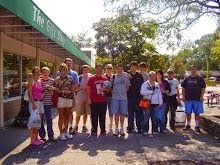
All the kids with Bob of the Cedar Grove Piggly Wiggly. All of the students had their first work experience at the Piggly Wiggly.

Tuesday, March 30, 2010

Students with disabilities need to be persistent

http://news.cincinnati.com/article/20100313/NEWS0102/3140325/1058/Learning+disabled+shouldn+t+rule+out+college

Program promotes confidence in workforce for people with autism

http://www.pittsburghlive.com/x/pittsburghtrib/news/westmoreland/s_672793.html

Program gives autistic students confidence to join work force
Shawn Curren hates when his hands are dirty.


When the students in his class at NHS Human Services Autism School in Whitney pass around cheese curls to eat, Curren, 16, of Greensburg immediately has to wash off the orange powder left on his fingers.

But when his boss at Adam and Eve Pet Station near Latrobe asks him to dig into a bag of hay and pull out handfuls to put in a rabbit cage, Curren obliges happily.

"Try to get it around the bowl here," pet store owner David Shultz tells Curren as he scoops up one last handful. "That's good!"

Curren's foray into the working world is part of NHS Human Services' transition program for autistic students who attend the organization's schools in Herminie and Unity.

It's an opportunity for autistic students at the two NHS schools in Westmoreland County to go out into the community, learn about different jobs and hone their skills so they're ready to work when they graduate from high school at age 21.

"If we don't start early, we're really setting them up for failure when they turn 21," said Sharon Greene, senior director of the schools.

With the unemployment rate for autistic adults as high as 80 percent and with one in 110 American children being diagnosed with the developmental disorder, the need to better prepare the students for adulthood takes on urgent importance, said Dr. Cathy Pratt, board chairwoman of the Autism Society of America.

"As the numbers increase, if these individuals are graduating into unemployment that means there will be a greater stress put on our economy and our social services," Pratt said. "We spend a lot of resources on early intervention and on educational programs and individuals are going to spend more of their years as adults than as children."

The schools began strengthening their transition services for students ages 14 and older last fall.

At the beginning of the school year, NHS opened laboratory work sites at both schools where kids could learn vocational skills, including office work, food preparation and horticulture.

They've put together pizza boxes and have done collating for offices in preparation for the real world.

About a month ago, students about age 16 began going out into local businesses to put what they learned in school to the test.

Tiffany Baer, an NHS intern, called businesses throughout the county to find places willing to give the students a chance. Some businesses were reluctant, Baer said, because they don't understand autism.

But those business operators who stepped forward have embraced the program.

"They work so well with the kids, and they're so willing to give us a chance," Baer said.

At Adam and Eve, students clean animal cages, feed fish and do other tasks to prepare Shultz for his business day.

"They come in on time, and they pick it up really well," Shultz said.

Curren said cleaning the cages is his favorite part of working at Adam and Eve.

"I want to have a job at the Pittsburgh Zoo to take care of the animals," Curren said.

The students get an opportunity to learn about a variety of jobs. NHS students have been going to Unique Pizza in Unity, Allante Hair Designs and Spa in Greensburg, and New Haven Court nursing home and Align Chiropractic, both in Hempfield, for their job experiences.

Students go to a site once a week and they rotate among businesses for variety, Greene said.

On a recent day, chiropractor Leah Samuels had some students placing Align Chiropractic labels on water bottles she is donating to a charity walk while another student cleaned the office.

She thinks she'll have the students do some office work, such as filing.

"As I learn their skills better, we'll try to find things that will make their skills grow," Samuels said.

Cassie Maywood, 15, found her skill set, cleaning the chiropractor's office.

She wiped down exam tables, dusted window blinds and vacuumed the floors. While she liked cleaning and did so with gusto, Maywood said her favorite job experience has been at the pet store working with the mice and birds.

Greene said NHS is preparing to open a new center in Greensburg in the fall where the transition program will be housed. Students will go there to develop portfolios, undergo evaluations and work on job skills.

"We can help them figure out what is it they want. Is it possible they are going to go onto education after they graduate? Are they going to need supported employment? Are they going to be able to do independent employment?" Greene said.

Breaking barriers to employment for youth with disabilities

http://www.washingtonpost.com/wp-dyn/content/article/2010/03/22/AR2010032202680.html

Breaking barriers to employment for youth with disabilities


As a teenager, Rachael Dorman participated in a program designed to help students who were visually impaired navigate the job market and transition into the next stage of life. This experience eventually led her to the Department of Labor in 2002, where she now devotes her energies to helping young people with disabilities prepare for the world of work or college long before their high school graduation day arrives.


"I realized this was an area where I wanted to work. It was a positive transition experience for me, and I wanted others to have that experience," Dorman said.

Dorman, who is legally blind, is a youth policy advisor in the Labor Department's Office of Disability Employment Policy. In this role, she promotes a series of government initiatives aimed at getting employers to consider hiring young people with disabilities and helping provide guidance for those coming out of high school or college.

"Employment is the barrier that impacts people with disabilities," Dorman said. "Our goal is to get the people who deal with employment to think about those with disabilities and give them the tools to work with youth with disabilities."

Many employers have misconceptions about people with disabilities, making it difficult when the disabled look for jobs, thus resulting in a high rate of unemployment for this sector of the population.

Dorman has worked on a variety of programs, including one that gave disabled high school students the chance to explore careers in science, mathematics and technology. She has helped run Disability Mentoring Day, a job shadowing day at workplaces for youth with disabilities, and managed an internship program to give youth with disabilities meaningful work experiences in government and the private sector.

Last year, the program recruited and interviewed about 2,000 students that resulted in 545 getting either summer internships or permanent positions in government or the private sector. Students routinely have been placed at a wide range of federal agencies including the Census Bureau, the National Aeronautics and Space Administration, the Department of Defense and the Labor Department.

Currently, Dorman is developing a 15-hour curriculum to help young people learn skills such as communication, problem solving, and taking initiative.

Dorman's office partners with government agencies and employer associations across the country to ease the transition for youth with physical, mental, learning, visual and other disabilities. She has also worked with community organizations like the Boys and Girls Clubs and other after-school programs offering advice and technical assistance to staff who work with youngsters who have disabilities.

Dorman noted that the transition to the workplace can be especially difficult for young people with disabilities. For example, she said one of the main conflicts is the choice of disclosure, particularly if the individual has a "hidden" disability but still might need some special assistance.

"College students think they are not supposed to disclose their disability," Dorman explained. "The choice is theirs, but if they will need an accommodation ¿ like flexible work schedules or specially designed software ¿ then they will have to disclose."

In her own case, Dorman said she uses a large screen computer with screen magnification software and carries a monocular wherever she goes to help her read things from a distance.

Nadia Ibrahim, senior policy advisor at the Labor Department disability program, said Dorman is committed both professionally and personally to her work, and is able to bring important insights to the job.

"She has a unique ability to help people understand what is necessary for young people with disabilities to succeed in the workplace," Ibrahim said.

Dorman said she gets great satisfaction from her job and the opportunity to help people. And she said there's the added benefit that "government agencies are flexible, which can allow them to create a more comfortable work environment for people with disabilities."

NCLB Embraces Transition

http://www.csmonitor.com/USA/Society/2010/0323/No-Child-Left-Behind-embraces-college-and-career-readiness

No Child Left Behind embraces 'college and career readiness'

Read any article on education these days, and chances are you'll come across the words "college- and career-ready." It's the catchphrase du jour – the goal of almost every education reformer on both the right and the left.


It's also the aim of the Common Core State Standards for student academic achievement across America, a draft report released earlier this month by the National Governors Association and the Council of Chief State School Officers.

In addition, the Obama administration's recently released proposal for rewriting the No Child Left Behind (NCLB) Act of 2001 calls for doing away with the 2014 goal of 100 percent proficiency in reading and math in favor of getting all students college- and career-ready by the time they graduate from high school.

Many education advocacy groups have already shifted their focus from simply raising graduation rates to making sure that students who graduate are ready for the next step.

But it's not always clear how such a shift toward college- and career- readiness standards would change the current education system.

What does 'college- and career-ready' mean?

Loosely, it means ensuring that students are prepared for college-level courses upon matriculation, or for a job that can support a family.

Another definition, suggested by Marc Tucker, president of the National Center on Education and the Economy, is whatever skills are required to succeed in credit-bearing courses at the community-college level.

Shouldn't graduation from high school mean that students are ready for the next step?

Currently, between 30 and 40 percent of students enrolling in college require at least one remedial class. Such courses don't give credits, don't qualify for tuition aid, and contribute to America's abysmal college completion rate: About half of all students who start college never finish. In a survey that the standards-advocate group Achieve conducted several years ago, employers said that about 40 percent of the high school graduates they hired didn't have the skills to advance in their jobs.

Is there agreement on what the standards should be?

The Common Core standards are the ones with the most buy-in so far. They emphasize cognitive skills – such as the ability to analyze a text coherently; write clearly and logically; and demonstrate precise, strategic mathematical thinking – in addition to core subject knowledge.

Some educators say an even broader range of attributes is necessary to succeed in college.

Any true measurement of college readiness has to include self-management skills and knowledge about the culture of college – including how to choose and apply to the right one – as well as academic skills and content knowledge, says David Conley, director of the Center for Educational Policy Research at the University of Oregon in Eugene.

"What students need to know in high school is not every detail," says Professor Conley. "They need a structure of knowledge, big ideas, and large organizing concepts."


.Is there a difference between college and career readiness?

It depends on whom you ask. The skills needed in college and at a job with a viable career path are very similar, says Mike Cohen, president of Achieve. This indicates, he adds, that high schools should be preparing every student for college-level work.

Others say there are some distinctions between college and job preparedness, although less research has been done on career readiness.

"They need to be a little more clear about what jobs they're really referencing," says Michael Kirst, a professor emeritus of education at Stanford University in California, who adds that the lack of specificity about "career readiness" is a weakness of the proposed common standards.

What progress has already been made?

Thirty-one states now have college- and career-ready standards, according to an Achieve report this year. That's up from the three that the organization counted five years ago.

Eight states, meanwhile, have signed on with Mr. Tucker's organization to begin measuring how well students measure up to such standards.

What tools do we have to measure college and career readiness?

Very few, which leads some critics to say that reformers are getting ahead of themselves. Almost everyone agrees that the current exams – generally computer-scored, multiple-choice tests designed for efficiency – are poor at measuring the sort of complex analytical skills and reasoning that are key to college readiness. The Obama administration has promised $350 million to help states develop good assessments.

Conley, of the University of Oregon, envisions a combination of teachers' assessments of skills that are hard to measure on tests and exams that require more sophisticated student responses, which will be graded partly by the teacher and partly by the state.

"It's harder to measure these skills, but it's not impossible," says Tucker. "The only way you can find out if students can write a decent 20-page history research paper is to ask them to write a 20-page research paper."

Is this a real change or just a repackaging of old goals?

Changing the standards without changing curricula, teacher training, and accountability would do little, but most advocates of college and career readiness hope it will eventually affect every aspect of the current system.

"Up until this time, our testing system has been designed as normative tests: Compare student A to all other students," says Tucker. "Now we're saying, here's a fixed standard and we have to get all or almost all kids to it. That's a shift of enormous proportions."

The change is much needed, says Conley. "If we don't get this right, I have a hard time seeing how the United States economy is going to maintain its place in the world. If we create two classes of people in this society – those who have access to these kinds of cognitive strategies and knowledge jobs and those who don't – the gap is going to continue to grow dramatically."

Assistive Technology helps people live independently

http://www.dallasnews.com/sharedcontent/dws/news/localnews/stories/DN-technology_28met.ART0.Central.Edition1.4d2d9f4.html


United Cerebral Palsy of North Texas helps those with disabilities use technology, live independently

Connie Prilliman has gone through life for 63 years without being able to say a word – until this month.

Prilliman was born with cerebral palsy, which limits muscle control. She cannot speak or type. She has communicated mostly by leaning toward the yellow sticker on her wheelchair that says "Yes" or shaking her head to indicate "No."
But earlier this month, Prilliman found her voice – through a computer that lets her eyes do what her fingers cannot.

It's a computerized female voice, but a voice nonetheless.

Instead of typing, Prilliman "presses" the keys on her computer-screen keyboard by looking at them. There are several phrases on the monitor, which is attached to her wheelchair. They include simple greetings such as "What's new?" and "Good to see you." There's also "Talk to me like an adult," for those who talk down to people with disabilities.

When she dwells on a phrase for a certain amount of time, the cameras reflect the glint in her eye to activate the key. Then the computerized voice says the phrase, said Leah Gardner, director of assistive technology for United Cerebral Palsy of North Texas.

Prilliman just received the device from the local branch of United Cerebral Palsy, which provides a wide range of services – from child development and education to adult rehabilitation and housing – to help people live as independently as possible. The branch even has its own technology lab.

The communication device requires great effort as Prilliman struggles to keep her eyes on one spot.

"It's recognizing her eyes," said Bill Knudsen, president and chief executive of United Cerebral Palsy, as Prilliman practiced one recent morning. "The challenge is focusing on what she wants to say."

Prilliman said her first words on March 4: "Please tell me if you don't understand what I am saying."

The device is one of many types of assistive technologies that United Cerebral Palsy uses to help people with disabilities go back to work, continue their educations or reconnect with friends and family.

The technology in Prilliman's communication device, similar to what physicist Stephen Hawking uses, has been available for about two years. But the costs – up to $18,000 for a system like Prilliman's – can make it out of reach for many.

United Cerebral Palsy receives state funding and private donations to purchase the equipment by a variety of manufacturers, and clients either pay for the technology or receive aid.

Prilliman received money from the state and got her ERICA II system by Eye Response Technologies on March 2.

Gardner said the next step will be advances in technology that can read brain waves, which would enable people who are completely paralyzed to use computers.

Steve Prilliman, Connie's brother, said he created a very rudimentary communication system for her in the 1970s when he was in college. With that system, Connie shifted her left arm to move blades that hit letters on a table.

Prilliman said he was happy his sister now has "something more advanced and easier to operate."

"She'll be able to do much more than she's ever been able to do before," he said. "It's a whole new world."

Prilliman's recent breakthrough also was exciting news at the nonprofit group's office.

"I sent out an e-mail to the entire building to say Connie was talking for the first time," Gardner said. She said people have been coming to observe and congratulate her ever since.

Prilliman, who lives on her own with help from caretakers, has been coming to United Cerebral Palsy for services for 30 years.

But Gardner said she has gotten to know Prilliman better in recent months by helping her use a service that provides books online to people with disabilities. Gardner showed her several categories of books, and Prilliman indicated "Yes" when she saw the biographies. Since then, she has read several books, including biographies on President Abraham Lincoln and Abigail Adams.

"I knew there was more in Connie than being able to say 'Yes' or 'No,' " Gardner said.

The technology takes a lot of practice. On a recent morning, Prilliman worked with Gardner in the lab as they continued to try out the new device.

"Hello, how are you?" Prilliman said. "What's up?"

"You're talking!" Gardner said. "That's what's up, Miss Connie.

Helping people with Autism work

http://www.post-gazette.com/pg/10088/1046417-114.stm
The Thinkers: Duquesne professor working to help autistic people work

A young man was cleaning an elevator at a local hotel recently when some guests entered the car.

"Say hi," said a young woman standing near the man. She wasn't being rude; she was just doing her job. The woman was a Duquesne University student who was assigned to mentor the young man, who had a high-functioning form of autism and was working at his first full-time employment.

Encounters like this one are a key part of the program devised by Duquesne special education professor Ann X. Huang to help people with autism succeed in the workplace.

Young men with Asperger syndrome or other forms of high-functioning autism, a neurobiological disorder that affects communication skills, can often learn the skills of a job fairly easily. What they struggle with is how to behave with people.

Dr. Huang's solution? Pair them with mentors who will stay with them throughout the work shift and coach them on how to interact with bosses, co-workers and customers.

After getting a pilot grant two years ago from the state Department of Public Welfare, Dr. Huang has now received a $25,000 grant from the advocacy group Autism Speaks to extend the program to Wesley Spectrum Services, a local agency that works with the families of developmentally disabled children.

Although the program's scope is modest -- it will be able to help only a few children to start with -- it is tackling one of the most critical and overlooked problems in the world of autism.

As children on the autism spectrum enter their teens, even those who can finish college often have extreme difficulty finding work. The unemployment rate for people with autism is estimated at 80 percent in America, and of the 20 percent who work, most are in part-time jobs, says Peter Bell, executive vice president of programs and services at Autism Speaks.

The challenge is so great that a new group called Advancing Futures for Adults with Autism was begun last year. At its national town hall meeting in November, Mr. Bell, speaking of his own teenage son, posed the questions that worry many families of young adults with autism.

"What happens when the school bus stops coming to our house? Where will he live? Will he have a job? Who will take care of him when we are not around? These questions weigh heavily on us."

Dr. Huang said the answers to those questions do not necessarily lie with teaching such children how to perform a job, but how to treat others while they're on the job.

"Some of them do not greet people mutually. People will say hi, but they will respond with no eye contact, or they might not respond at all," she said.

"On other occasions, they might be too nice to other people -- they don't realize they should keep a certain distance. Some of them are very sensitive to sensory stimuli, so if they like the smell of someone else's shampoo they might come too close to the other person and that might offend some people or scare them."

One good way to meet those challenges, she said, is to pair the autistic workers, most of them young men, with college-age peers who understand all those unwritten rules of social engagement.

In her pilot programs, Dr. Huang has tended to use young women as mentors, because the autistic men respond better to them. But for certain situations, such as when the men are in a public setting, she prefers male mentors.

One example: on a public bus trip, an autistic man was very attracted to a young woman who had boarded the bus. "We say to these young men, 'If you see a woman, you should keep a certain distance from her and you should not stare at her all the time.' A lot of autistic people have good memories so they can remember those rules, but it is sometimes hard for them to generalize the behavior."

In this case, she said, the young man told his mentor that even though he knew the rules, he still wanted to sit near the young woman, but his male mentor physically pulled him back.

Dr. Huang's pilot program worked with the St. Anthony School Programs, a Catholic system for children with Down syndrome, autism and other disabilities. She is now trying to extend the mentoring system to Wesley Spectrum Services, which works with more than 7,000 children across Western Pennsylvania.

So far, the autistic students have worked at Duquesne's cafeteria, law school and copying center, as well as at the Pittsburgh Marriott City Center housekeeping program and a few other work sites.

Finding willing employers is crucial, she said, but even when she can do that, there is sometimes still the issue of insensitive co-workers.

She went to observe one of her students at a local grocery store recently, where he was bagging at a checkout counter. The boy has Down syndrome and autism, she said, so he is both friendly and tends to repeat himself.

"He was saying, 'It's fun outside, do you like it?' He has good verbal communication and he was trying to greet people, but the problem is he repeats things again and again and again." It clearly irritated the cashier, said Dr. Huang, who did not let on that she knew the young man.

"The cashier was not very happy about the way he was acting. I had bought some eggs, and she asked if I wanted her to put my eggs in a bag, because 'I don't want him to ruin your eggs.' I said 'No, no, no, he's doing fine.'

"He was doing his job very well. The only part that embarrassed the cashier was that he was very friendly and didn't know the boundaries."

Dr. Huang never expected to end up doing this kind of work. When she was 24, she was a successful young English teacher at an elite school in Beijing for the children of wealthy parents. Then, she happened to visit a school for developmentally disabled children, and her life changed.

"The school I was teaching in was so different from this one, and it totally changed my mind. In Chinese society, we always think out of sight, out of mind. But I decided we cannot ignore them."

She applied for a graduate program at Tennessee Tech University, where her mentor specialized in autism, and joined the Duquesne faculty after getting her Ph.D.

Her only frustration has been that her funds for the mentoring program have been so limited. "If other agencies would like to replicate this program or other school districts were interested in developing such a program, I'd be more than happy to help them develop it.

"I hate to refuse parents. They ask, 'How can we get our kids into your program?' and too often, I have to say 'I'm so sorry, the money is limited.' "